
Arrow Escape vs Traffic Escape: Which One Fits You
By JingPublished Updated 9 min read1,682 words
In this guide
Arrow Escape vs Traffic Escape is a comparison between two games that share every rule and differ in what the eye has to read. Both are one-tap escape puzzles on a packed grid: a piece leaves when the straight lane in front of its head is empty to the edge, a blocked tap costs one of four hearts, and from the second level on a clock runs at four seconds per piece. The difference is that one draws arrows and the other draws winding vehicles with a car at the nose.
That makes this an unusual comparison, and it is written to be honest about the fact. The sections below state what is identical, what actually differs, what each game is not, and which players each one will not suit. The Arrow Escape side uses the measured boards behind the complete guide; the Traffic Escape side uses the rules read from its code, without level-by-level detail.
What is identical: the rules, the hearts, the clock
Both games check one thing when you tap: the straight line from the head of the piece to the edge of the board, in the direction the head points. If every cell on that line is empty, the piece leaves and its whole body follows along its own path. If any cell is occupied, the tap is blocked. In Arrow Escape the head is the cell with the arrowhead; in Traffic Escape it is the nose, where the car is drawn. The winding body behind either one never matters.
The economy is the same to the number. Four hearts per level. A blocked tap costs one, and tapping the same blocked piece again is free until something else changes, so the expensive mistake is switching to a neighbor. Running out of hearts offers one heart back or a retry.
The first level has no clock; after that the clock is four seconds per piece on the board, with a two-minute floor, rounded up to five seconds, and running out offers two more minutes or a retry. Retry resets the streak of consecutive clears, and both games show the same streak banners at three, five, ten and fifteen.
Board structure is the same too. Every board is completely packed, so at the start the only pieces that can move are the ones whose head sits on an edge pointing off it. Removing a piece only empties cells, so a piece that can move stays movable, and no order of moves can make a level unsolvable. The move-order article explains that property for Arrow Escape, and it holds for Traffic Escape by the same rule.
What actually differs: the reading task
The difference is visual, and it changes how the board is read. Arrow Escape draws every piece as a thin path with an arrowhead at the end, in a palette of twenty colors; the head is small and the direction is a glyph. Traffic Escape draws each piece as a long colored roadway with a car at the nose, in six colors; the nose is a larger object, the direction is the way the car faces, and a piece that drives off trails exhaust smoke as it goes.
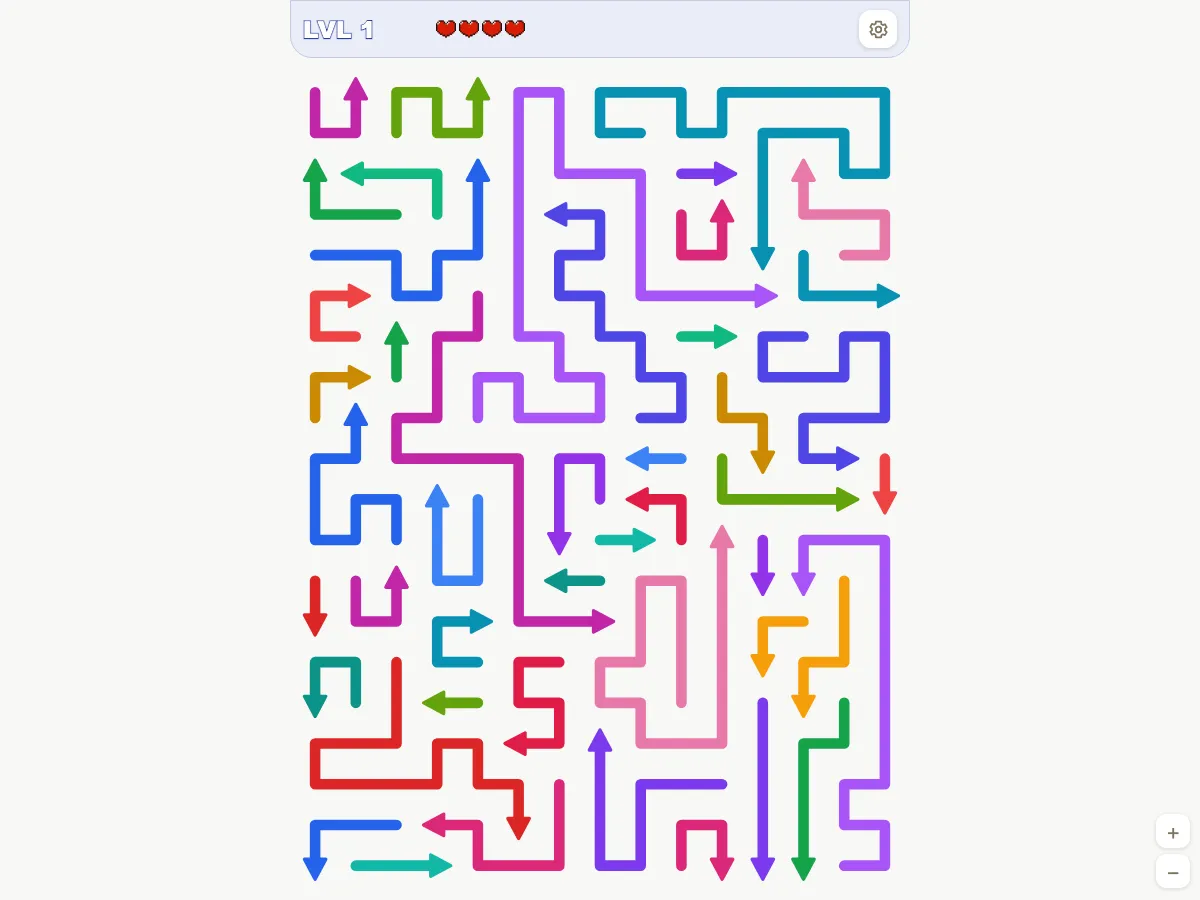
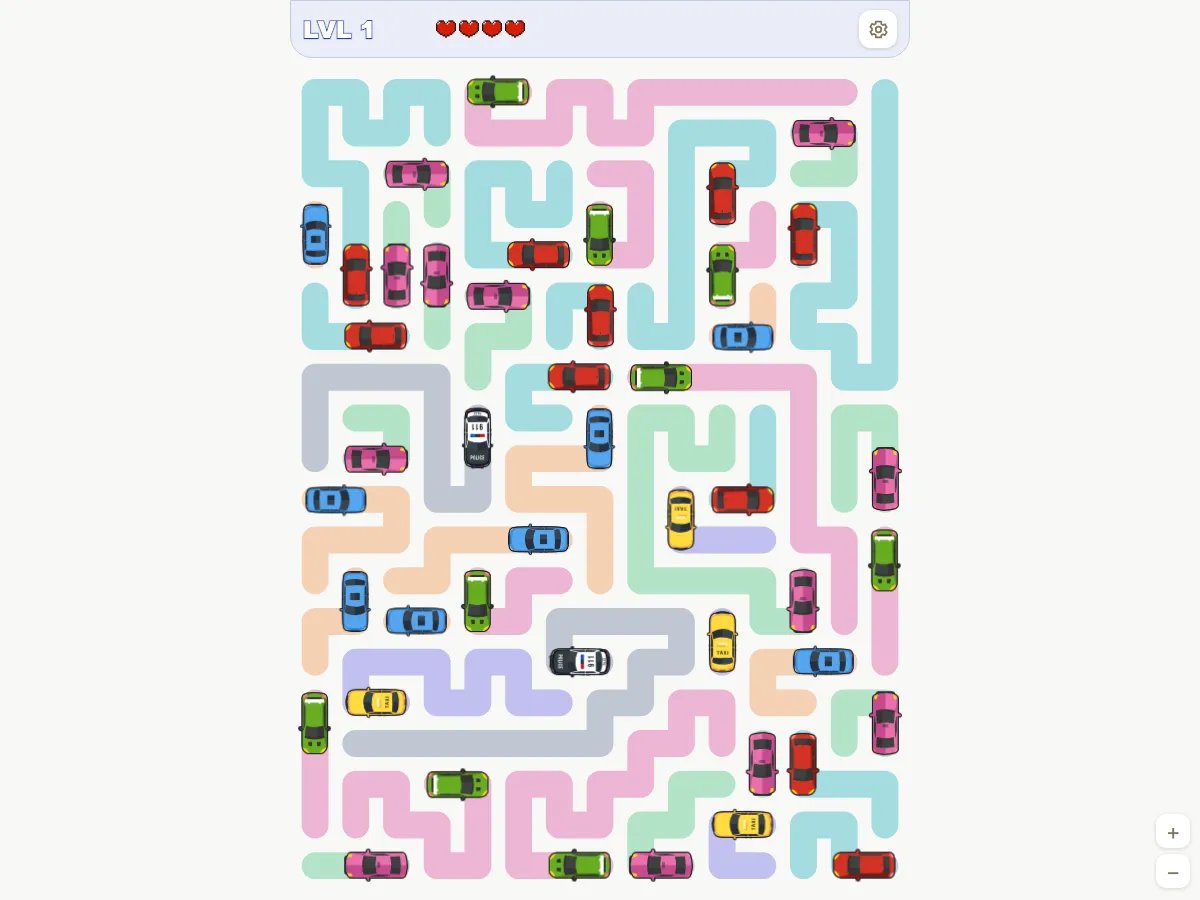
Those choices move the difficulty around without changing it. Fewer colors mean adjacent Traffic Escape vehicles are more often the same color, so the body of one is harder to tell from its neighbor; a larger nose means the head is easier to find at a glance. Arrow Escape's twenty colors separate neighbors better, and its arrowheads are smaller targets that need a closer look. Which is easier to scan is a matter of eyes, not rules.
One consequence is practical. On dense boards the habit that clears both games is to scan the four edges for heads pointing off the board, and the two games make that scan feel different: in one you look for arrowheads at the border, in the other for cars facing outward. Players who switch between the games report having to re-learn the scan, briefly, each time, because the target shape changed and nothing else did.
What Traffic Escape is not: the Rush Hour expectation
The name invites a comparison that does not hold, and it is the most important thing to know before choosing. Rush Hour, in Wikipedia's description, is a sliding block puzzle whose goal is to get only the red car out through the exit of the board by moving the other vehicles out of its way. Vehicles slide back and forth within the grid, moves can be undone, and a bad sequence can leave the red car stuck.
Traffic Escape is a different kind of puzzle. Vehicles do not slide within the grid; they leave it, once, when their lane is clear, and the goal is to empty the board. There is no red car, no exit square, and no position that traps you. A player who wants the Rush Hour experience, the back-and-forth shuffle toward a single goal, will not find it here, and the guide to traffic jam puzzles as a genre draws that line in full.
The distinction also explains the difficulty ceiling. General sliding-block puzzles are formally hard: Hearn and Demaine proved them PSPACE-hard even with domino pieces, which is why a Rush Hour position can be genuinely deep. Both games on this site sidestep that by making every move permanent, so their difficulty is in reading the board quickly under a clock, not in searching a maze of positions. Some players want the first kind of difficulty and will find the second thin.
| Arrow Escape | Traffic Escape | |
|---|---|---|
| Exit rule | Head's straight line to the edge must be empty | Same, with the car's nose as the head |
| Hearts, blocked taps, same-piece rule | 4, cost 1, repeat free | Same |
| Clock | None on the first level; then 4 s per piece, 2-minute floor | Same |
| Continue offers | +1 heart or +120 s | Same |
| Streak banners | 3, 5, 10, 15 | Same |
| Pieces | Arrows, 20 colors, small arrowhead | Vehicles, 6 colors, car at the nose, exhaust on exit |
| Progress | Browser storage, own key | Browser storage, own key |
| Guides on this site | Measured level by level | Mechanics only |
Which players each game will not suit
Arrow Escape is not for players who want a theme. It is a grid of colored lines with arrowheads, and it never pretends otherwise; there are no cars, no story, no scenery, and the twenty-color palette exists to separate neighbors, not to decorate. A player who needs a reason to care about the pieces will not get one, and the game's abstraction is a feature only for people who prefer it.
Traffic Escape is not for players who arrive expecting Rush Hour, as the previous section explains, and it is not for players who find same-colored neighbors hard to separate. With six colors on a packed board, adjacent vehicles share a color often, and reading where one body ends and the next begins is part of the difficulty. Players with color-vision differences may find the arrow version's larger palette and distinct arrowhead glyph easier to work with, though neither game has been tested for that.
Neither game is for players who want a fresh puzzle after finishing the other. The rules are identical, the boards grow the same way, and the habits transfer completely; the second game is the first game in different clothes. That is worth saying plainly, because it is the answer to the comparison most people are actually asking: if you have played one, you know both, and the choice is about which picture you prefer to read.
How to decide in one level
The quickest way to choose is to play the first level of each, which has no clock in either game. On Arrow Escape's first board, seven arrows can move at the start, and the habit to learn is scanning the edges for arrowheads pointing off. On Traffic Escape's first board the habit is the same scan for cars facing outward, and the question is which target your eye finds faster. The beginner tips describe the habits for the arrow version, and every one applies to the vehicle version.
Then stay with the one whose board you read more easily. Difficulty in both comes from the same place, the number of pieces that can move and the length of the chains between them, so the game that reads faster is the game where the clock bites later. Switching later costs nothing but the brief re-learning of the scan, and progress in each is kept separately.
For the vehicle version there is a walkthrough of the early game, written from the mechanics rather than from measured boards, in the Traffic Escape early-levels guide. For the arrow version, the complete guide documents every tenth level and the three levels that change how the game feels.
What to read next
The comparison above is honest about its asymmetry: the Arrow Escape side rests on measured boards and the Traffic Escape side on rules. For the arrow game, the complete guide is the reference and the beginner tips are the shortest route to the three habits that clear both games. For the arrow game that does change the rules, with one tile per arrow and three hearts, see the Arrow Puzzle Tap Away guide.
For the vehicle game, how to solve traffic jam puzzles places Traffic Escape within the genre it is named after and explains where the Rush Hour family and the one-tap family part ways, and the early-levels walkthrough covers the situations a new player meets first.
Or run the experiment: play Arrow Escape for one level, then play Traffic Escape for one, and notice which board your eye reads first. That answer is the whole comparison, and it is one that no guide can make for you, because it depends on how you see rather than on how the games are built.
arrow escapetraffic escapecomparison
Play the games


Frequently asked questions
- Is Traffic Escape the same game as Arrow Escape?
- The rules are the same: a piece leaves when the straight lane in front of its head is empty, a blocked tap costs one of four hearts, the first level has no clock and later ones give four seconds per piece. What differs is the look: winding vehicles with a car at the nose instead of arrows with an arrowhead.
- Which one is easier?
- Neither by rule; the difficulty comes from the board, and both games grow their boards the same way. Players who find arrowheads easier to scan than car noses will read Arrow Escape faster, and the reverse is true for players who track vehicles more naturally. The guides for Arrow Escape are more detailed because its boards have been measured.
- Does progress carry over between the two games?
- No. Each game keeps its own progress in the browser, under its own key, on the device it is played on. Hearts, streaks and levels reached in one game have no effect on the other, and there is no account that links them.
Sources
- Rush Hour (puzzle) — Wikipedia (Accessed September 5, 2026)
- PSPACE-Completeness of Sliding-Block Puzzles and Other Problems through the Nondeterministic Constraint Logic Model of Computation — Erik Demaine, Theoretical Computer Science (2005) (Accessed September 5, 2026)
External links are provided for reference and are not endorsements.