
7 Common Arrow Escape Mistakes and How to Fix Them
By JingPublished Updated 10 min read1,862 words
In this guide
The Arrow Escape mistakes that cost the most hearts are not misreadings of a hard board. They are habits that feel reasonable and happen to be wrong on every board, and each one can be shown on a specific level with the real arrows in place. This article lists the seven that come up most, explains why each one fails against the actual rules, and gives the fix.
The rules that make them mistakes are short. An arrow leaves only if the straight line from its head to the edge is empty. Every board is fully packed. A blocked tap costs one of four hearts, except that tapping the same blocked arrow again is free. From level 2 the clock is four seconds per arrow. Everything below follows from those four sentences.
Mistake 1: judging arrows by their length
The most natural instinct on a crowded board is to go for the biggest arrow, on the theory that it is either the key to the level or the hardest thing to get rid of. Neither is reliably true. On 56 of the 100 levels the longest arrow leaves in the first quarter of the solve, because a long snake often ends at an edge with its head already free. On 17 levels it leaves after the halfway point, and on some it is a decoy.
Level 47 is the decoy case: its 32-cell arrow, with its head in the sixteenth row pointing right, is not free until the 34th of 56 layers. Level 10 is the opposite: its 42-cell arrow, the longest on the board, leaves in the third layer. On level 1 the 27-cell arrow looks like the first move and is the second, because its head is three cells short of the right edge and all three cells belong to a 4-cell arrow that has to go first.
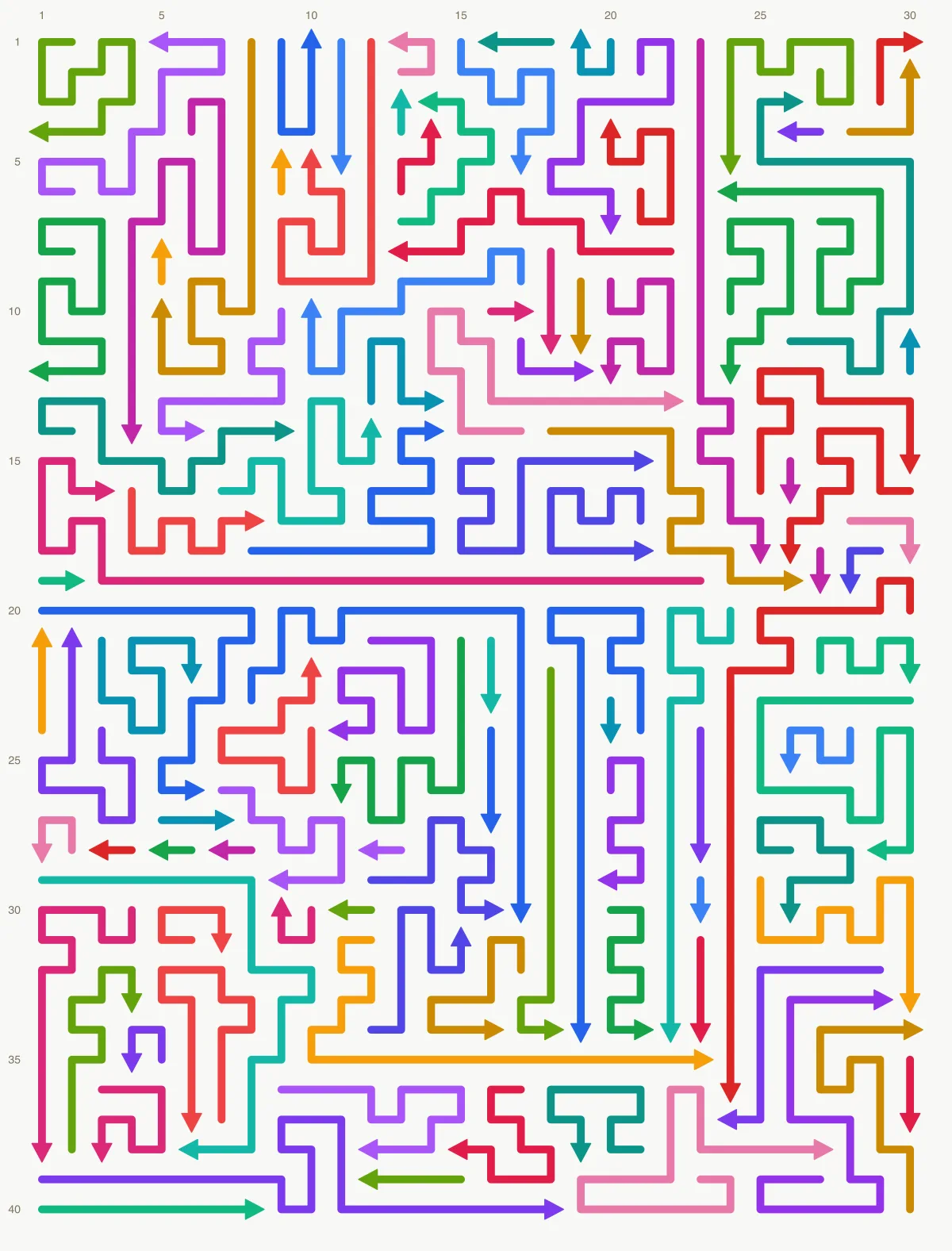
The fix is to look at the head and ignore the body. A long arrow is exactly as easy to remove as a short one once its line is clear, and exactly as impossible before. Length is information about how many cells will empty when it leaves, which matters for planning the next move, and nothing else.
Mistake 2: tapping an interior head at the start of a level
At the start of every level no cell is empty, so an arrow whose head is not on an edge has an occupied cell directly in front of it and cannot move. This is true of all 100 boards without exception. The arrows that can move are the ones whose head sits on an edge pointing off the board: seven on level 1, eight on level 2, one on level 3, six on level 47, ten on level 100.
Tapping anything else on the first move is a guaranteed heart. On level 3 there is one legal tap out of 65 arrows, in the top-right corner. On level 96 there are two out of 137, both on the top edge. The larger the board, the worse the odds: on level 10 a random first tap loses a heart 96 percent of the time.
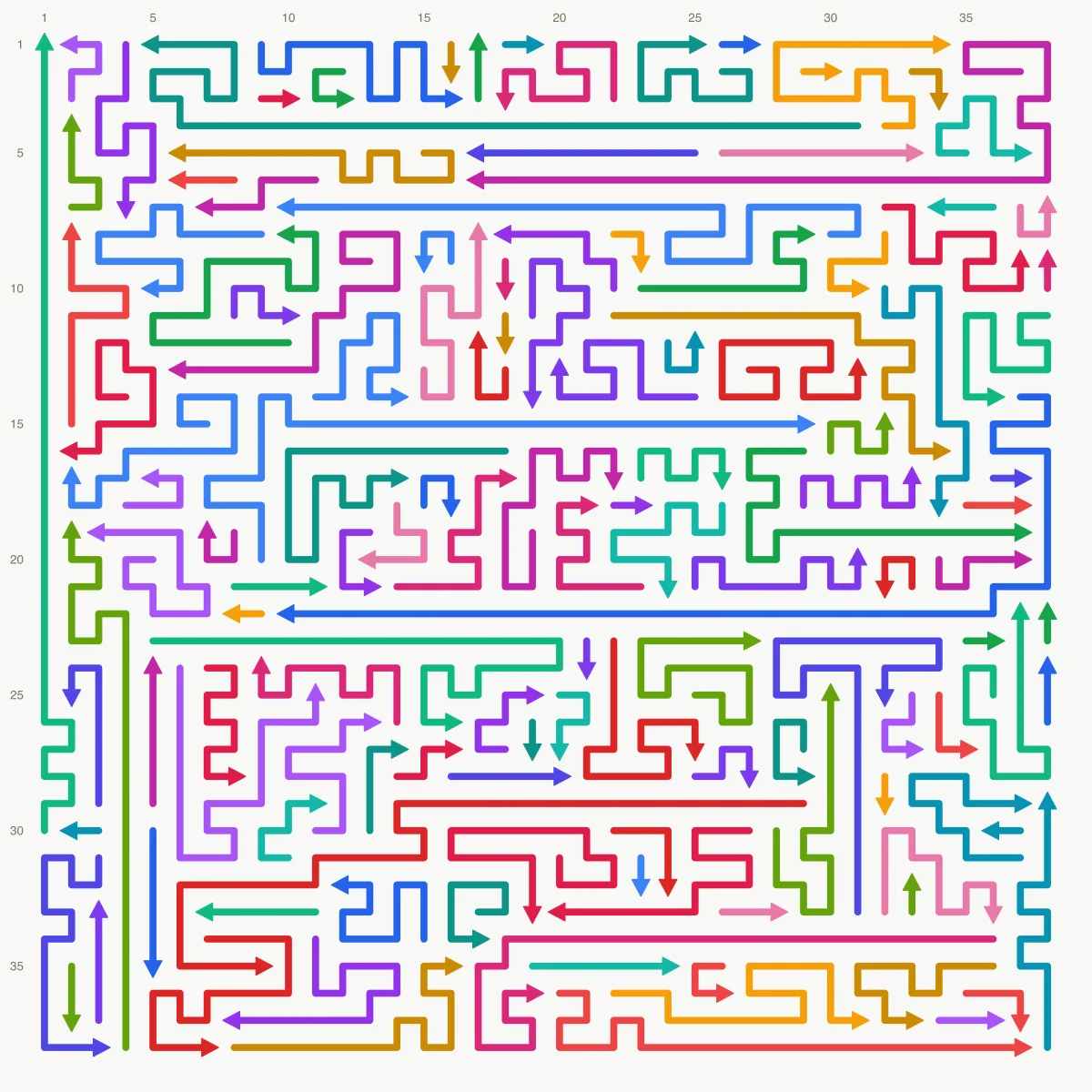
The fix takes five seconds. Scan the top edge for heads pointing up, the bottom for heads pointing down, the left for heads pointing left, the right for heads pointing right. That is the complete list of first moves, and it is the opening habit that the beginner tips build everything else on.
Mistake 3: switching arrows after a blocked tap
A blocked tap costs a heart, and the reflex is to try the arrow next to it. That is the most expensive reflex in the game, because of a rule most players never learn: the game remembers the last arrow that blocked you, and tapping that same arrow again costs nothing. Tapping a different blocked arrow costs another heart. Two guesses on two arrows is two hearts; two guesses on one arrow is one.
The memory clears when any arrow successfully leaves, when you retry, and when you accept the extra heart after running out. So after a block, the free information is which arrow flashed. Follow its line from the head to the first occupied cell. The arrow in that cell is your real target, or it is itself waiting on the arrow in front of it. Either way the search moves along one line instead of across the neighborhood.
The fix is a rule for the moment after a block: no new arrow until you have traced the flashed one. On level 3, players who lose all four hearts before the first arrow moves lose them on four different arrows in the middle of the board. Four taps on the same wrong arrow would have cost one. That free repeat is specific to Arrow Escape; in Arrow Puzzle Tap Away every blocked tap costs a heart, a repeat included.
Mistake 4: tracing only the cells near the head
An arrow's line has to be empty all the way to the edge, and on larger boards that line crosses more arrows than it looks. At the start of level 1 the average line from a head to the edge crosses between two and three other arrows, and the longest crosses eight. On level 47 the average is five and the maximum sixteen. On level 100 the average is eight and one line crosses 28 distinct arrows.
A trace that stops after three or four cells will call many of those lines clear. The 27-cell arrow on level 1 is the smallest example: three occupied cells between its head and the edge, all belonging to one 4-cell arrow. On level 100, where lines run up to 43 cells across the board, a trace has to go to the border every time or it is a guess.
The fix is to move your eye, or your finger without pressing, from the head to the edge before every tap, and to zoom in when the cells get small. The board zooms with a pinch or the on-screen buttons and pans by dragging. Four seconds per arrow on the clock is enough for a full trace of a confirmed candidate; it is not enough to recover from a heart lost to a short one.
Mistake 5: losing the thread in a single-choice stretch
Most levels have stretches where exactly one arrow can move, one layer after another. The average level has about eleven such layers, 59 levels have ten or more, and level 86 has 27. In a stretch like that, every arrow but one is blocked, and hunting around the board is a heart per guess. Level 11 has a run of seven: in the middle of it, four 2-cell arrows along one row all point right and can only leave from right to left, each one freeing the next.
The thread is always the same: the cells that just emptied. The arrow that becomes free next is the one whose head points into those cells, and on a single-choice layer it is the only free arrow on the board. Lose track of which cells emptied and the stretch turns into a guessing game; keep track and it is a sequence of obvious moves.
The fix is to watch the exit, not the next candidate. When an arrow slides off, note the path it vacated, then look for an arrowhead pointing into the nearest of those cells. The hard-levels guide walks through the stretches on levels 11 and 18 arrow by arrow.
Mistakes 6 and 7: the wrong retry, and the wrong pace
Mistake 6 is retrying when the extra heart is better. When hearts hit zero the game offers one heart back, with the board and clock as they are, or a retry with the full board, four hearts and the full clock. Retry also resets your streak of consecutive clears to zero. If most of the board is already cleared, the remaining lines are shorter and one heart is usually enough; retry throws away the work and the streak. Retry is the right call early in a level, not late.
Mistake 7 is playing the large boards at the pace of the small ones. Every tenth level is a much larger board, from 162 arrows on level 10 to 241 on level 100, and the clock is four seconds per arrow. Spent tracing from scratch after each tap, four seconds is tight. Spent tapping an arrow you confirmed while the previous one was animating, it is comfortable. The tens boards reward a queue of two or three confirmed arrows and punish a fresh search each time.
The same instinct causes both: treating the game as a series of independent taps rather than a sequence. Arrow Escape belongs to the family of sliding puzzles, with one difference, that pieces leave the board instead of shuffling, so the board only ever gets easier. Order still decides the cost, and in the general case of sliding-block puzzles Hearn and Demaine proved that deciding a solution is PSPACE-hard even with domino pieces. The reading cannot be skipped; it can only be done in the right order.
| Mistake | Costs | Fix |
|---|---|---|
| Tapping by length | Hearts on decoys like level 47's 32-cell arrow | Check the head's line, ignore the body |
| Interior head at the start | A guaranteed heart | Scan the four edges for heads pointing off |
| Switching after a block | A heart per new arrow | Trace the flashed arrow; repeats are free |
| Short traces | Hearts on lines that cross 5 to 8 arrows | Trace to the edge, zoom when small |
| Losing the thread | Hearts in single-choice stretches | Watch the cells that just emptied |
| Late retry | The streak and the cleared board | Take the single heart when the board is mostly empty |
| Small-board pace on tens boards | The clock | Keep a queue of confirmed arrows |
What to read next
Each of these mistakes is the failure of one of the three habits in the beginner tips, and the habits are easier to learn on level 1, where there is no clock, than to unlearn on level 47. For the levels where the mistakes cost the most, how to beat hard Arrow Escape levels gives the real openings for levels 3, 39 and 96. The same mistakes, with vehicles in place of arrows, are the situations in the Traffic Escape early-game walkthrough.
Why order matters at all, and why a game this strict about sequence can never become unsolvable, is in why move order decides arrow puzzles. The full reference for every level is the complete guide. Or play Arrow Escape and count how many of the seven you catch yourself making on the first three levels. Level 1 has no clock, so it is the right place to make them cheaply; level 3, with one legal first move, is where the second and third mistakes start charging full price.
arrow escapemistakespuzzle strategy
Play the game

Frequently asked questions
- Why do I lose hearts on the first tap in Arrow Escape?
- Because at the start of a level only arrows whose head touches an edge, pointing off it, can move. The board is fully packed, so every interior head has an occupied cell in front of it. Scan the four edges first; level 1 has seven such arrows, level 3 has exactly one.
- Should I retry or take the extra heart when I run out?
- If most of the board is already cleared, the single heart is usually better: the remaining lines are shorter and the clock keeps its current value. Retry restores the full board, four hearts and the full clock, but it resets your streak of consecutive clears to zero.
- Is the biggest arrow always the last to leave?
- No, and assuming so is its own mistake. On 56 of the 100 levels the longest arrow leaves in the first quarter of the solve; on 17 it leaves after the halfway point. Level 47's 32-cell arrow is a decoy, level 10's 42-cell arrow leaves in the third layer. Check the head, not the length.
Sources
- Sliding puzzle — Wikipedia (Accessed August 31, 2026)
- PSPACE-Completeness of Sliding-Block Puzzles and Other Problems through the Nondeterministic Constraint Logic Model of Computation — arXiv (Hearn & Demaine) (Accessed August 31, 2026)
External links are provided for reference and are not endorsements.