
Traffic Escape Walkthrough: The Early Game
By JingPublished Updated 10 min read1,761 words
In this guide
This Traffic Escape walkthrough is organized by situation rather than level by level: the rules as the game's code applies them, and the recurring positions a player meets in the early game, in the order they usually appear. Every level in the early game is one of these situations or a combination of them.
So this guide covers the clockless first board, the arrival of the clock, the edge scan that opens every level, the blocked tap and the rule that makes a repeat free, the tight boards where only one vehicle is free at a time, and the two continue offers. Where it says "when a board looks like this," it means exactly that, and no more.
The first board: no clock, and the only rule that matters
The first level has no timer, which makes it the place to learn the one rule everything else depends on. A vehicle drives off the board when the straight lane from its nose to the edge is empty. Its body, however long and however it winds, follows it out along its own path and never needs a clear lane of its own. If any cell in the nose's lane is occupied, the tap is blocked and costs a heart.
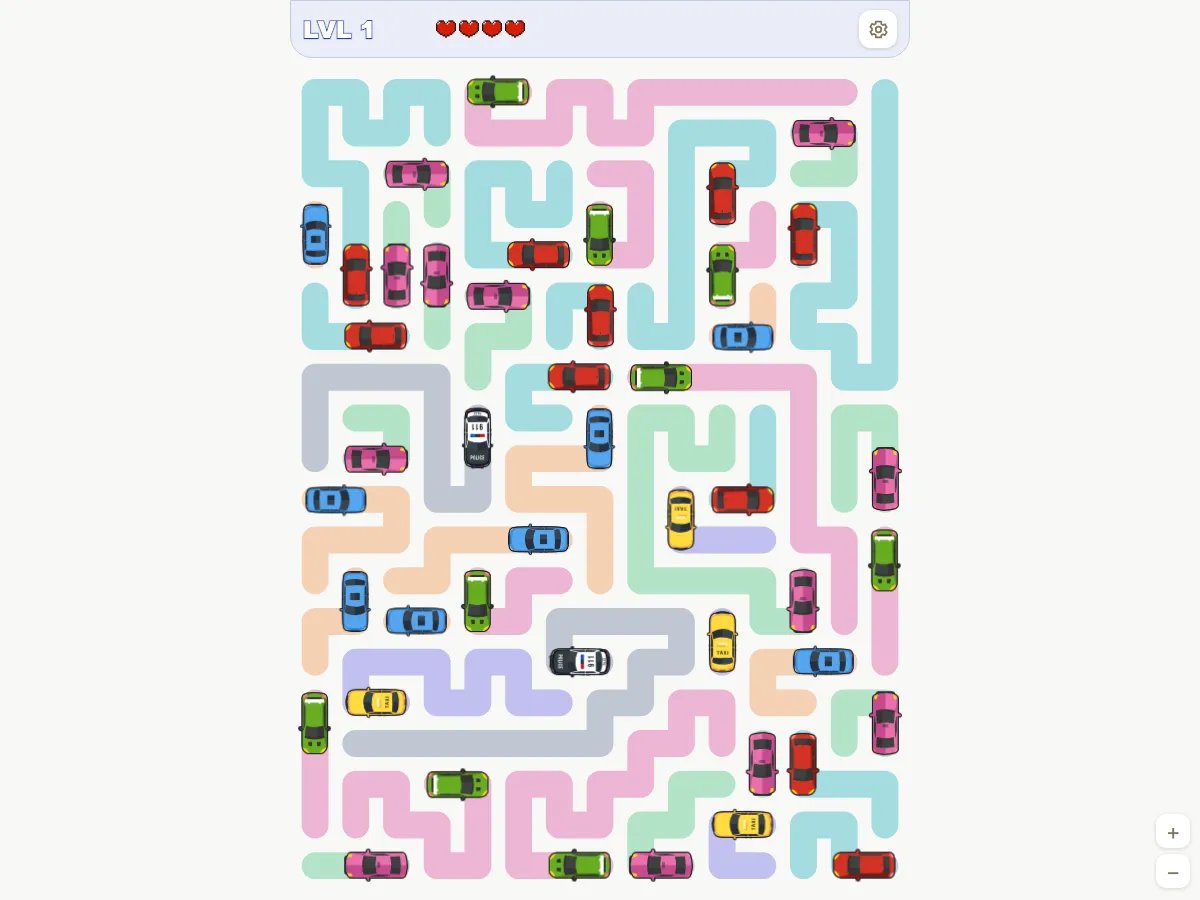
Because every board is packed, with each cell belonging to some vehicle, the first consequence is that a vehicle whose nose is not on an edge has an occupied cell in front of it and cannot move. The vehicles that can move at the start are exactly the ones whose nose sits on an edge, facing outward. On the first board, find them by looking along each edge for a car pointing off the board, and tap only those until the board starts to open.
Use the missing clock to practice the trace. Before every tap, run your eye from the nose along the lane to the edge and confirm each cell is empty. On the first level that costs nothing but time; on every later level it is the habit that saves hearts.
When the clock arrives: four seconds per vehicle
From the second level on, a countdown appears, and its length is set by the board: four seconds for every vehicle on it, with a floor of two minutes, rounded up to the next five seconds. A small early board with a few dozen vehicles gives a few minutes; larger boards give more, in proportion. The clock pauses whenever an overlay is showing, so reading the level-complete screen costs nothing.
Four seconds per vehicle is tight if each one is traced from scratch and comfortable if the tracing overlaps the driving. The routine that keeps pace is to confirm the next vehicle's lane while the current one is pulling away, so that every tap is on a vehicle already checked. A player who taps and then starts looking is spending the budget twice.
When the clock reaches zero the board freezes and the game offers two extra minutes or a retry. The two minutes come with the board exactly as it is, which is almost always worth taking when the board is more than half clear. Retry restores the full board, four hearts and the full clock, and resets the streak of consecutive clears.
The edge scan: how every level opens
The opening of every level is the same procedure, and on tight boards it is the whole difficulty. Scan the top edge for cars facing up, the bottom for cars facing down, the left for cars facing left, and the right for cars facing right. That list is the complete set of legal first moves. Any tap outside it is a heart.
The list can be long or very short. When an early board offers several outward-facing cars, the order among them barely matters, and the level opens quickly. When a board offers only one or two, every other vehicle is waiting on those, and the level is hard for exactly one tap. A long vehicle along an edge with its nose free is the most productive first move on any board: its body is a wall, and the vehicles facing that edge from inside are waiting on it.
After each departure, the lane that emptied is the new edge. Look at the cells the vehicle vacated and find the nose pointing into the nearest of them; that vehicle is usually the next one free. This is the chain the whole game runs on, and the beginner habits for Arrow Escape describe the same routine with arrows in place of cars. The wall, the chain and the other shapes behind these situations are laid out in the board patterns every unblock puzzle reuses.
| Situation | What it means | What to do |
|---|---|---|
| Nothing looks movable | Only edge-facing noses can move on a packed board | Scan all four edges for a car pointing off |
| One long vehicle along an edge, nose free | Its body is a wall for everything behind it | Tap it first |
| A tap is blocked | Something sits in the nose's lane | Trace the lane; go after the first occupied cell; do not switch |
| Several vehicles free at once | The board is opening | Take the one that empties the longest lane |
| One vehicle free at a time, repeatedly | A tight stretch | Follow the cells that just emptied |
| Hearts at one, board mostly clear | Late-level risk | Take the heart back, not the retry |
The blocked tap, and the rule most players miss
A blocked tap costs one heart, and there are four. The rule that changes how to respond is this: the game remembers the last vehicle that blocked you, and tapping that same vehicle again costs nothing until something changes. Tapping a different blocked vehicle costs another heart. The memory clears when any vehicle successfully leaves, on retry, and when you accept a heart back.
So the expensive reflex after a block is to try the neighbor. The cheap response is to stay with the vehicle that flashed: trace its lane from the nose to the first occupied cell, and the vehicle there is the real target, or is itself waiting on the one in front of it. The search moves along one lane instead of across the neighborhood, and a second look at the same vehicle is free.
The same rule shapes the endgame. When hearts hit zero the game offers one heart back, keeping the board and clock as they are, or a retry. With most of the board already clear, the remaining lanes are short and one heart is usually enough; the retry throws away the cleared board and the streak. Early in a level, when little has been cleared, the retry is the better deal.
Tight stretches: when only one vehicle is free
Boards go through stretches where exactly one vehicle can move, and then the one it frees, and then the one that frees. In those stretches the board is not hard to read; it is strict about order, and the only clue to the next vehicle is the cells that just emptied. Lose that thread and the stretch becomes a guessing game at a heart per guess.
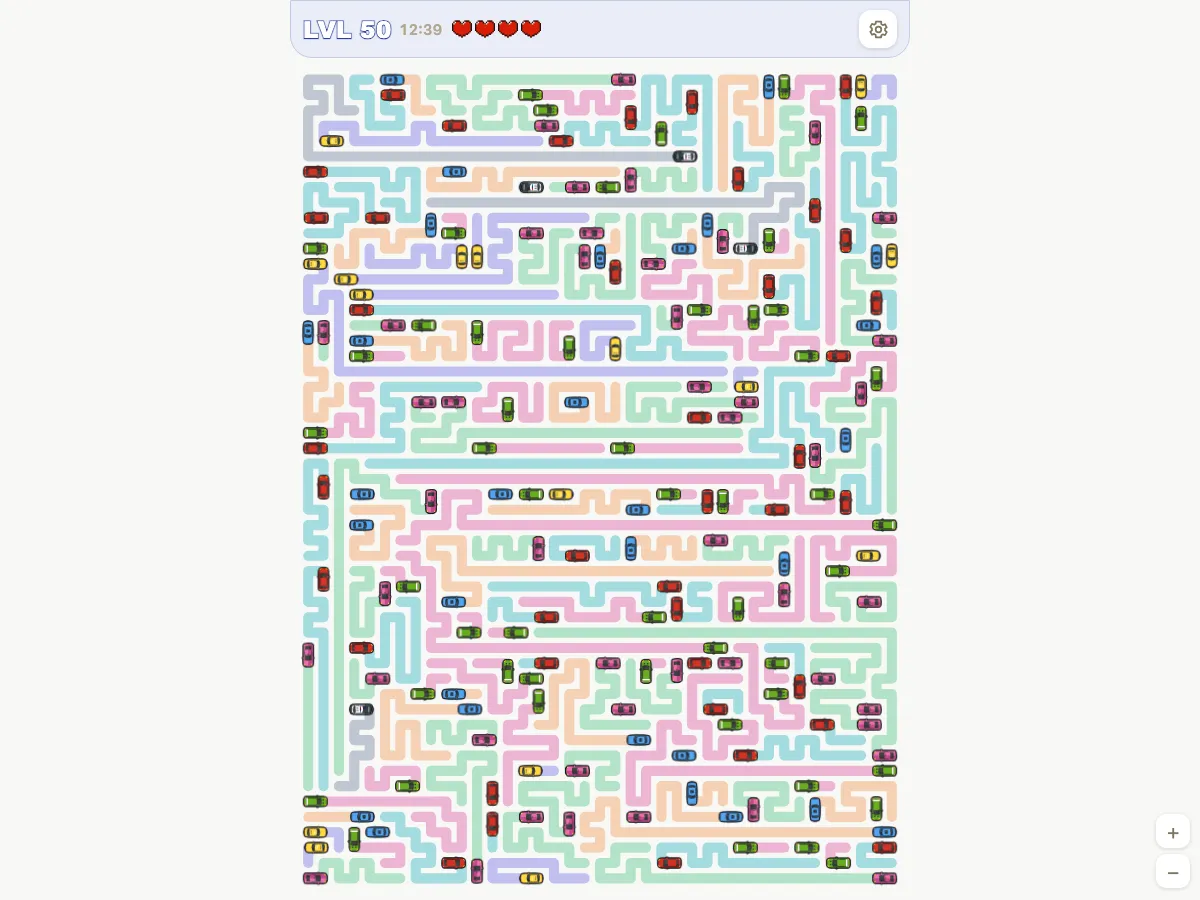
The way to hold the thread is to watch the exit rather than hunt for the next candidate. When a vehicle drives off, note the lane it vacated, then look for a nose pointing into the nearest of those cells. In a tight stretch that vehicle is the only free one on the board. If the lane it vacated frees nothing obvious, look at the cells its body vacated too, because the winding body can uncover a nose far from the exit lane.
These stretches are also why the game cannot be lost by bad reasoning. Every departure only empties cells, so a free vehicle stays free until tapped, and no order of moves can make a level unsolvable. That separates the one-tap family from the sliding puzzles it resembles: Wikipedia notes that a sliding block puzzle prohibits lifting any pieces off the board, the constraint that makes dead ends possible, and general sliding-block puzzles are PSPACE-hard even with domino pieces. Here a wrong order costs only hearts and clock.
Reading the board on a phone versus a desktop
The early game is where players settle into a device, and the two differ. On a phone the board is smaller and the vehicle bodies thinner, so dense areas need the pinch zoom and the drag pan the game provides; on a desktop the scroll wheel zooms and there is more room to see the whole board at once. Both are worth learning before the boards get large.
Two habits help on any screen. Zoom into the edges, not the middle, during the opening scan, because the edges are where the legal moves are. And zoom back out after each stretch, because the lane a vehicle vacates can free a nose on the far side of the board, and a zoomed-in view will not show it.
The game keeps its progress in the browser on the device being used, under its own key, separate from Arrow Escape's. Switching devices means starting from the first level on the new one, which on the early boards is no great loss and is a second chance to learn the scan.
What to read next
The situations above are the whole early game, and they recur, in denser combinations, all the way through. How to solve traffic jam puzzles places Traffic Escape in its genre and explains why its strategy differs from Rush Hour's, which is the mismatch that catches most new players. Arrow Escape vs Traffic Escape says plainly what the two games on this site share and which players each will not suit.
For the reading skill in its most measured form, the Arrow Escape beginner tips show the edge scan and the chain on boards that have been counted arrow by arrow, and everything in them applies to vehicles.
Or begin where this guide begins: play Traffic Escape, use the clockless first board to practice the trace, and tap nothing whose lane you have not followed to the edge. The situations above will arrive in roughly the order listed, and each one is easier to recognize the second time. They are the same situations, with aircraft in place of cars, in the Helicopter Escape guide.
traffic escapewalkthroughpuzzle strategy
Play the game

Frequently asked questions
- Why does my car not move in Traffic Escape?
- Because something is parked in the straight lane ahead of its nose. The winding body behind the car does not matter; only that lane does. Trace from the nose to the edge, find the first occupied cell, and the vehicle there is what has to leave first. Tapping the same blocked car again costs nothing.
- Is there a time limit in Traffic Escape?
- Not on the first level. From the second level on, the clock gives four seconds for every vehicle on the board, with a floor of two minutes, rounded up to five seconds. It pauses whenever an overlay is showing. Running out offers two extra minutes or a retry.
- What happens when I run out of hearts?
- The board freezes and you choose between one heart back, which keeps the board and the clock as they are, or a retry, which restores the full board, four hearts and the full clock but resets your streak of consecutive clears to zero. Late in a level the single heart is usually better.
Sources
- Sliding puzzle — Wikipedia (Accessed July 6, 2026)
- PSPACE-Completeness of Sliding-Block Puzzles and Other Problems through the Nondeterministic Constraint Logic Model of Computation — arXiv (Hearn & Demaine) (Accessed July 6, 2026)
External links are provided for reference and are not endorsements.