
The Rush Hour Puzzle and How Modern Clones Changed It
By JingPublished Updated 9 min read1,705 words
In this guide
The Rush Hour puzzle is the reason a whole genre of games is called traffic jam puzzles, and its history is short enough to tell in full: a Japanese inventor in the 1970s, an American company in 1996, a deck of 40 cards, and a 2002 proof that the game is as hard as puzzles get. The digital games that followed kept the theme and changed the rules, sometimes slightly and sometimes completely, and the changes explain why two games called traffic puzzles can play nothing alike.
This article traces that line from the sliding puzzles of the 1880s through Rush Hour to its clones and to the one-tap games on this site, using the documented history and the formal results. It states what the sources say and stops there; where the record is silent, for instance on how many levels a given app has, it does not guess.
Before Rush Hour: the sliding puzzles of the 1880s
Rush Hour is a sliding block puzzle, and the family is older than the car. The oldest member is the fifteen puzzle, the four-by-four frame of numbered tiles with one gap, whose history is often told wrong. Wolfram MathWorld records that the actual inventor was Noyes Chapman, the Postmaster of Canastota, New York, and he applied for a patent in March 1880. Wikipedia adds that Chapman's invention set off a puzzle craze in the early 1880s, and that Sam Loyd, who claimed to have invented it, is often wrongly credited.
The fifteen puzzle also produced the first mathematical result about sliding puzzles, and it is the ancestor of every hardness proof since. MathWorld states it plainly: odd permutations of the puzzle are impossible to solve, shown by Johnson in 1879, while all even permutations are solvable, shown by Story in 1879. Half of all arrangements can never be reached, no matter how many moves are made, which is why Loyd could safely offer a prize for solving one of them.
Between the fifteen puzzle and Rush Hour came Klotski, a sliding block puzzle thought to have originated in the early twentieth century, in which a large block must be slid to an exit at the bottom of the frame past smaller blocks that never leave. Its default layout needs a minimum of 81 moves, a figure verified by computer. Klotski is the direct conceptual parent of Rush Hour: one special piece, an exit, and a crowd of others that must be shuffled but never removed.
Rush Hour: one inventor, one company, forty cards
Rush Hour was designed by Nob Yoshigahara, a Japanese inventor, collector and communicator of puzzles who lived from 1936 to 2004 and licensed his designs to companies including Binary Arts. Wikipedia's article on the puzzle states that it is a sliding block puzzle invented by Nob Yoshigahara in the 1970s, first sold in the United States in 1996, and that it is now manufactured by ThinkFun, the company formerly called Binary Arts.
The physical object is specific. The board is a six-by-six grid with grooves in the tiles to allow cars to slide. Cars and trucks are both one square wide; cars are two squares long and trucks three. The goal is to get only the red car out through the exit of the board by moving the other vehicles out of its way. The set ships with 40 puzzle cards, each giving a starting arrangement, graded in difficulty.
Two design decisions from that box defined the genre. Vehicles move only along their own length, so a horizontal car never becomes a vertical one, and every piece except the red car stays on the board from the first move to the last. Everything a Rush Hour player learns, the backward chain from the exit, the truck that has to move first, the move that looks wrong because it goes away from the exit, follows from those two constraints. The traffic puzzle strategy guide lays out that method.
The 2002 proof: why the board game is genuinely hard
Rush Hour earned a place in theoretical computer science six years after it reached shops. Wikipedia records that Gary Flake and Eric Baum showed in 2002 that when the game is generalized so that it can be played on an arbitrarily large board, the problem of deciding if a Rush Hour problem has a solution is PSPACE-complete. That is a formal way of saying that no shortcut can decide, for every position, whether the red car can get out; in the worst case the positions must be explored.
Three years later Robert Hearn and Erik Demaine generalized the result to the whole family. Their paper in Theoretical Computer Science showed that classic unrestricted sliding-block puzzles are PSPACE-hard, even if the pieces are restricted to be all dominoes and the goal is simply to move a particular piece. Rush Hour's trucks and grooves are not what make it hard; two-square pieces on a grid are already enough.
For a player the result has a practical meaning that the article on why traffic puzzles are hard develops: the difficulty of a Rush Hour card is real and not a failure of the solver. A hard card may need a long sequence with backward moves, and there is no rule of thumb that always finds it. That is also why the puzzle has stayed in print for three decades with a deck of 40 cards: the cards do not run out of depth.
| Puzzle | Origin | Special piece | Pieces leave the board? | Known result |
|---|---|---|---|---|
| Fifteen puzzle | Noyes Chapman, patent applied 1880 | None; arrange all tiles | No | Half of arrangements unsolvable (1879) |
| Klotski | Early 20th century | One large block to the exit | No | Minimum 81 moves for the default layout |
| Rush Hour | Nob Yoshigahara, 1970s; sold 1996 | Red car to the exit | No | PSPACE-complete when generalized (2002) |
| One-tap escape (Traffic Escape) | Browser game, this site | None; clear the board | Yes, every piece | Always solvable; order sets the cost |
The digital clones: what changed and what did not
Rush Hour went digital early and often. Wikipedia lists Blocked, a 2009 puzzle game for the iPhone and iPod Touch made by Joel Rosenberg and based on Rush Hour, and notes that an official iOS version of Rush Hour itself was released in 2010. The many mobile games called unblock, parking or traffic puzzles that followed are, in most cases, the same rule on a screen: a grid, sliding vehicles, one that has to reach an exit.
What the screen changed was not the rule but the supply. A box holds 40 cards; an app holds as many levels as its makers care to author or generate, and it can grade them, time them, hint at them, and sell hints. The card was a fixed object that a player worked through and set aside. The app is an open-ended sequence, and its economics, which the article on how free browser games make money describes, favor levels that keep coming.
The other change was subtraction. Some digital descendants dropped the sliding altogether: a vehicle no longer moves within the grid but leaves it, once, when the way ahead is clear, and the goal is no longer one car's escape but the whole board's. That is Traffic Escape's family, a different puzzle in the same theme. Nothing in it can trap the player, because every move only empties cells, and its difficulty is in reading the board quickly rather than in searching positions. The move-order article explains that property in detail.
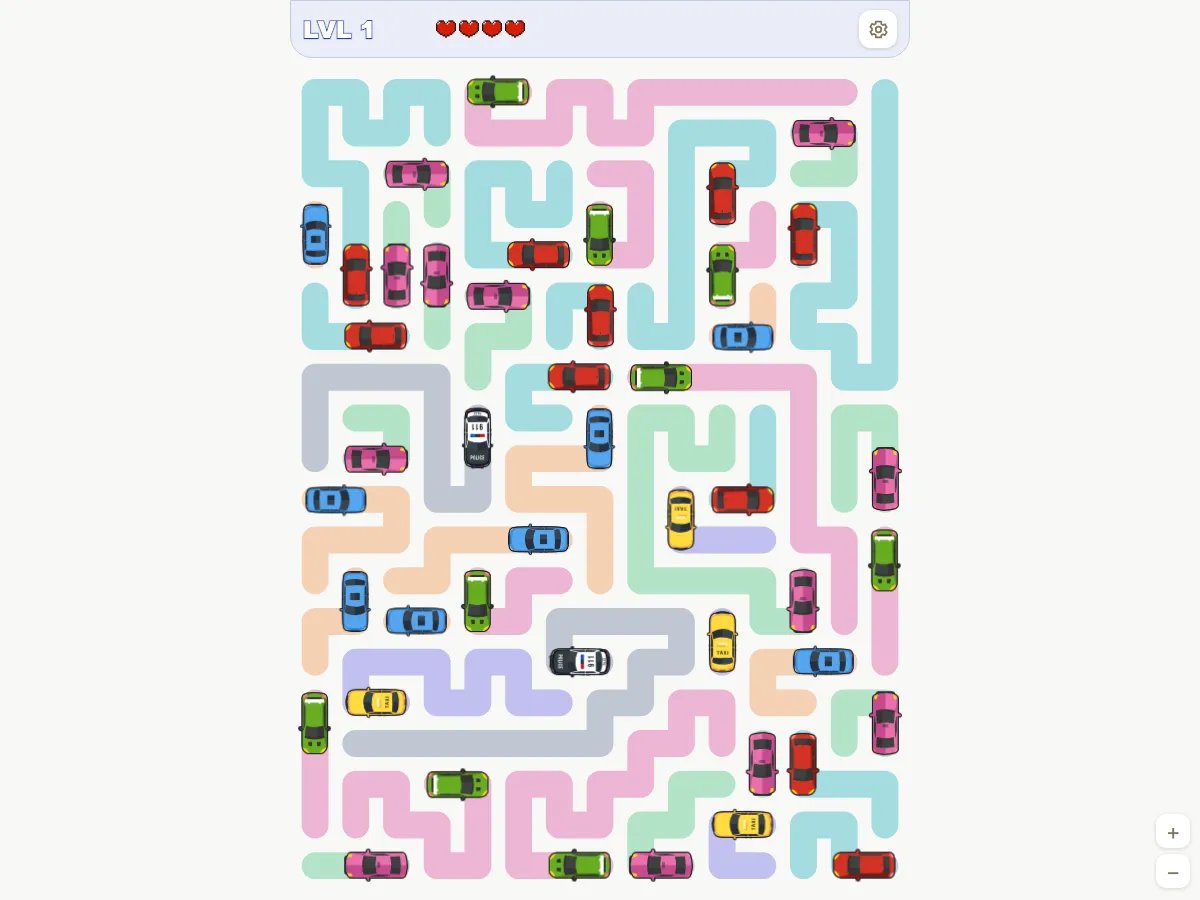
Two families under one name, and how to tell them apart
The shared theme hides the split, and store listings do not help; "traffic", "unblock" and "parking" are used for both families. The test is one move. If a vehicle slides a square and stops, staying on the board, the game is a Rush Hour descendant, and the strategy is the backward chain from the exit. If a vehicle drives off the board and does not come back, the game is a one-tap escape, and the strategy is the edge scan and the chain of emptied lanes.
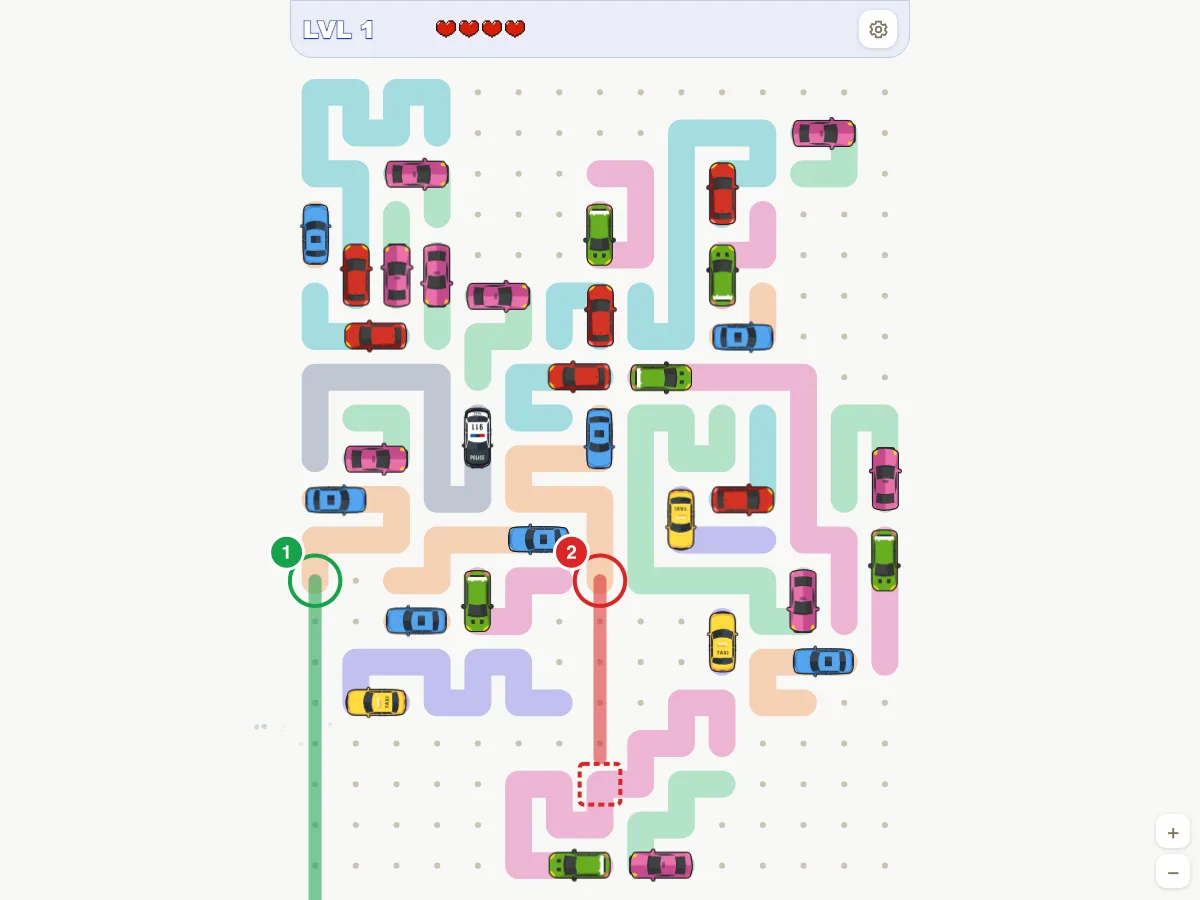
The families also feel different to lose. A Rush Hour position can be genuinely stuck, and the player's job is to find the sequence, however long. A one-tap board cannot be stuck; the player's only cost is the hearts spent on taps whose lane was not clear and the clock spent looking. One is a search problem with a right answer somewhere in the tree. The other is a reading problem with the answer on the screen, if the eye can find it fast enough.
The patterns that repeat across both families, the wall along an edge, the pair of blockers that need the same square, the chain that must be cleared in one order, are catalogued in the board patterns article. They are the reason a Rush Hour player is not lost in Traffic Escape, and a Traffic Escape player is not lost with a deck of cards; the reading transfers even when the rule does not.
What to read next
The strategy that follows from each family's rules is laid out in how to solve traffic jam puzzles, with the backward chain for the sliding kind and the edge scan for the one-tap kind side by side. The formal results mentioned here, from the 1879 parity proofs to the 2002 and 2005 hardness theorems, are explained for non-mathematicians in why traffic puzzles are mathematically hard.
For the recurring structures that both families reuse, seven board patterns every unblock car puzzle reuses names them and says which family each belongs to, which is the practical residue of a century of sliding puzzles.
And for the one-tap descendant itself, play Traffic Escape: the first board has no clock, and the first tap will tell you which family you are in, because the car will drive away rather than slide. That single difference is the whole distance between a 1996 box of cards and a browser tab.
rush hourpuzzle historysliding puzzles
Play the game

Frequently asked questions
- Who invented the Rush Hour puzzle?
- Nob Yoshigahara, a Japanese puzzle inventor who lived from 1936 to 2004, designed it in the 1970s and licensed it to Binary Arts, the company now called ThinkFun, which first sold it in the United States in 1996. The physical game is a six-by-six board with sliding cars and trucks and a deck of 40 challenge cards.
- Is Rush Hour mathematically hard?
- Yes, in the formal sense. Gary Flake and Eric Baum showed in 2002 that when the game is generalized to an arbitrarily large board, deciding whether a position can be solved is PSPACE-complete. Hearn and Demaine later showed sliding-block puzzles are PSPACE-hard even when every piece is a domino.
- How is Traffic Escape different from Rush Hour?
- It keeps the traffic theme without the sliding. Vehicles in Traffic Escape drive off the board for good when the lane ahead of the nose is clear, and the goal is to empty the board, so there is no red car, no exit square, and no position that can trap you. It is a different family with a different strategy.
Sources
- Rush Hour (puzzle) — Wikipedia (Accessed September 11, 2026)
- 15 Puzzle — Wolfram MathWorld (Accessed September 11, 2026)
- PSPACE-Completeness of Sliding-Block Puzzles and Other Problems through the Nondeterministic Constraint Logic Model of Computation — Erik Demaine, Theoretical Computer Science (2005) (Accessed September 11, 2026)
External links are provided for reference and are not endorsements.