
7 Board Patterns Every Unblock Car Puzzle Reuses
By JingPublished Updated 11 min read2,040 words
In this guide
An unblock car puzzle, whichever of the two families it belongs to, is assembled from a small set of structures that recur on almost every board. A vehicle sits across the lane the goal piece needs. A long vehicle lies along an edge and pins everything behind it. Two blockers need the same square. A sequence of pieces can only leave in one order. Learn to see seven of these and a new board stops being a jumble and becomes a list of known problems in a new arrangement.
This article names the seven, describes what each one wants, and says which family it belongs to: the sliding family, where vehicles move within a grid and a red car must escape, or the one-tap family, where every vehicle leaves the board for good. The descriptions come from the rules of each family, not from particular levels, and the caveat at the end is important: patterns tell you where to look, and the formal results say that is all they can do.
Pattern 1: the exit-lane blocker
The first pattern is the definition of the genre. In the sliding family, the goal piece is the red car, and Wikipedia's description of the original board game states the goal as getting it out through the exit of the board by moving the other vehicles out of its way. Whatever sits in the red car's row between it and the exit is an exit-lane blocker, and it has to move out of that row before anything else matters.
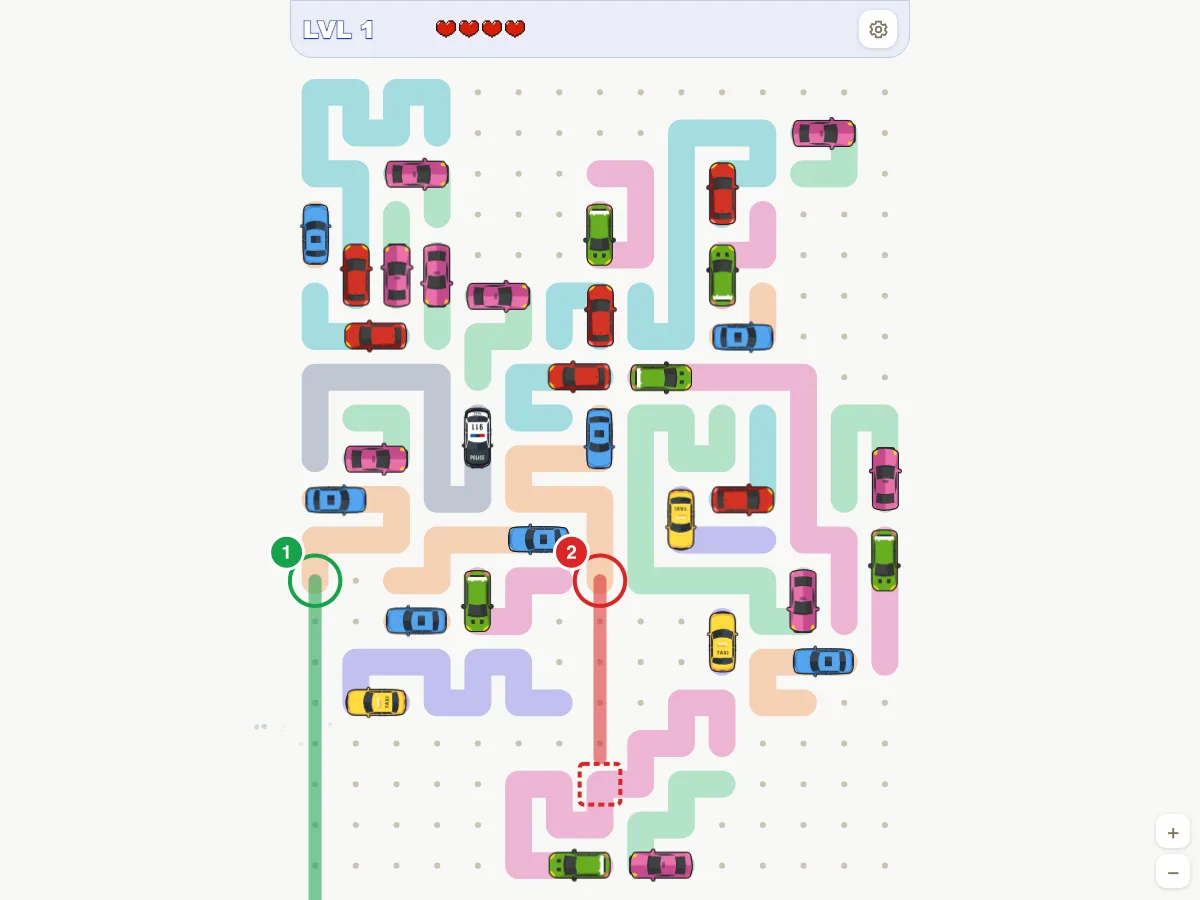
In the one-tap family there is no goal piece, so every vehicle has its own exit lane: the straight line from its nose to the edge. Whatever occupies that line is the blocker, and on a packed board every vehicle whose nose is not on an edge has one. The pattern is the same shape, a lane and something in it, and the response is the same: identify the blocker, then ask what the blocker itself is waiting on.
Reading this pattern is the entire first step of both strategies in the traffic puzzle guide. A player who can see which vehicle is in the lane has already found the next thing to think about.
Pattern 2: the wall along an edge
A long vehicle lying along the edge of the board, with its length parallel to the edge, is a wall. Every vehicle behind it that faces that edge is waiting on it, and nothing they do can free themselves until the wall goes. In the sliding family the wall is usually a truck, three squares long on the six-by-six board, and it can move only along the edge, into whatever room exists at either end.
In the one-tap family the wall is the most productive first move there is. When such a vehicle's nose is free, tapping it removes the whole wall at once and opens every lane that ran into it, which can free several noses in a single move. When its nose is blocked, the wall is the level's real problem, and the chain to clear it starts wherever its nose points.
The wall is also the pattern behind most hard openings. A board where only one or two vehicles can move at the start is usually a board where the movable ones are walls, and the whole interior is waiting on them.
Pattern 3: the crossing pair
Two blockers that each need the same square to move into cannot both move first, and one of them will have to move twice or move somewhere else. This is the crossing pair, and it exists only in the sliding family, because it depends on vehicles moving within the grid and competing for room.
The response is to work out which of the two can be served by a move that does not use the contested square, or which one can wait. Often the answer is that one of the pair must first move away from the exit, to a square it does not want, so that the other can pass; that backward-looking move is pattern 6 below, and the crossing pair is the most common reason it is needed.
There is no crossing pair in the one-tap family. Vehicles do not move into squares; they leave, and leaving never competes for room. Two vehicles whose lanes cross are simply two vehicles that each need their own lane clear, and one of them will be free before the other. The pattern that replaces it is the chain.
Pattern 4: the chain
A chain is a sequence of vehicles each of which frees exactly the next. In the sliding family it appears as a dependency line from the exit inward: the red car waits on a blocker, the blocker waits on a second vehicle for room, the second waits on a third. In the one-tap family it appears as a stretch of the solve where exactly one vehicle is free at a time, and the only clue to the next is the lane the last one vacated.
The chain is the pattern that punishes guessing. Inside a chain, every vehicle but one is blocked, so a tap anywhere else is a wasted move in the sliding family and a lost heart in the one-tap family. The way to hold a chain is to watch what the last move opened rather than to search the board: in a sliding puzzle, the square that just emptied; in a one-tap puzzle, the lane and the cells of the body that just left.
A chain of ten forced moves is trivial to execute once it is seen; the difficulty is entirely in seeing the first link. The Arrow Escape mistakes article describes losing the thread in a chain as one of the seven habits that cost the most hearts, and the habit is identical with vehicles.
| Pattern | Sliding family | One-tap family | What it wants |
|---|---|---|---|
| 1. Exit-lane blocker | The vehicle between the red car and the exit | Whatever sits in the lane ahead of a nose | Identify it, then ask what it waits on |
| 2. Wall along an edge | A truck pinning a row or column | A long vehicle whose body blocks every lane into that edge | Remove it first if its nose is free |
| 3. Crossing pair | Two blockers needing the same square | Does not occur | Decide which one waits, or moves twice |
| 4. Chain | A dependency line from the exit inward | A stretch with one free vehicle at a time | Follow what the last move opened |
| 5. Mutual block | Two vehicles each in the other's way | Two vehicles whose lanes run into each other's bodies | Find the third piece that frees one |
| 6. Backward move | A vehicle moves away from the exit to make room | Does not occur | Accept the detour |
| 7. Corner pocket | A vehicle boxed in a corner with one escape square | A nose in a corner facing off the board | Corners are free moves in one family, last moves in the other |
Patterns 5 and 6: the mutual block and the backward move
The mutual block is two vehicles that are each in the other's way: A cannot move because of B, and B cannot move because of A. In the sliding family it is resolved by a third vehicle whose move gives one of the pair room; in the one-tap family it is resolved the same way, since one of the two must be freed by something else leaving, and the search is for that something. Both strategies must widen their view beyond the pair.
The backward move belongs to the sliding family alone. It takes a vehicle away from the exit, or into a square it will have to leave again, because that is the only way to open room for another piece. It feels wrong and is sometimes unavoidable. Hearn and Demaine's result explains why: general sliding-block puzzles are PSPACE-hard, even if the pieces are restricted to be all dominoes and the goal is simply to move a particular piece, which means some positions require sequences that no forward-only rule will find.
The one-tap family has no backward move, because it has no moves that can be undone or that make anything worse. That is not a simplification of the sliding rule; it is a different rule with a different consequence, and the consequence is that no one-tap board can trap the player. The history article traces how the digital clones arrived at that subtraction.
Pattern 7: the corner pocket
The corner is the pattern the two families read in opposite directions. In the sliding family a vehicle boxed into a corner has at most one square to move into, and freeing that square may be the hardest part of the card; corners are where pieces get stuck. In the one-tap family a nose in a corner facing off the board is free by definition, and a corner whose vehicle lies along the edge is the wall pattern with its exit already open.
That is why the edge scan in one-tap puzzles starts with the corners, and why the backward chain in sliding puzzles often ends there. A player switching families should reverse the instinct: the corner that was a trap becomes the first tap, and the corner that was a free move becomes the last piece to worry about.
The reversal is a small example of the larger point. The seven patterns recur in both families because both are grids of vehicles with lanes, but what each pattern wants depends entirely on whether vehicles slide or leave. Reading the pattern is half the skill; knowing which family you are in is the other half.
Why patterns cannot replace solving
Patterns are where to look, not what to do. The formal results are clear about the limit: Flake and Baum showed the generalized Rush Hour decision problem is PSPACE-complete, and Hearn and Demaine's preprint on arXiv extends the hardness to sliding-block puzzles with domino pieces. In plain terms, no finite set of patterns solves every sliding position, and a hard card can defeat a player who knows all seven of these perfectly. The article on why traffic puzzles are hard explains those results without the notation.
In the one-tap family the patterns carry more weight, because there is no search problem for them to fall short of. Every position is solvable, and the only question is which vehicle is free now. A player who can see the wall, the chain and the corner pocket on a one-tap board has most of the game, and the rest is the four seconds per vehicle on the clock.
So the honest use of this list is as a vocabulary. Name the structure in front of you, remember which family you are in, and respond as that family allows. In a sliding puzzle that begins a search; in a one-tap puzzle it ends one. Either way the board is no longer a jumble, and that is what patterns are for.
What to read next
The strategies these patterns feed into are set out in full in how to solve traffic jam puzzles, with the backward chain for sliding boards and the edge scan for one-tap boards. Where the two families came from, and why one subtracted the sliding rule, is in the Rush Hour history article.
The reason patterns cannot be a complete method for sliding puzzles, and why they nearly can for one-tap puzzles, is the subject of why traffic puzzles are mathematically hard, which explains the theorems behind the caveat above.
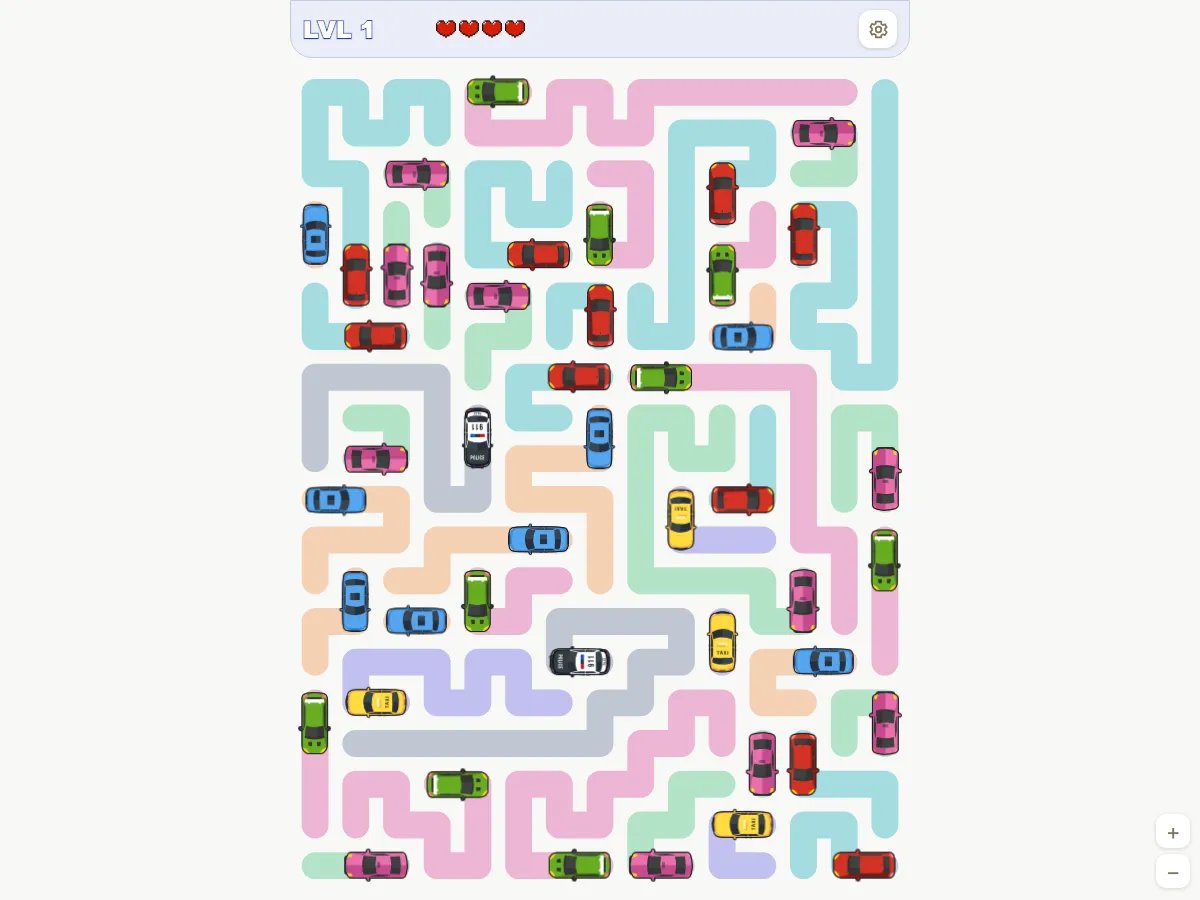
And to see patterns 1, 2, 4 and 7 on a real board, play Traffic Escape: on the clockless first board, find the corner nose, the wall along an edge, and the first chain, in that order. Naming them once on a board with no clock is what makes them visible later on a board with one, when there is no time to name anything.
unblock puzzleboard patternspuzzle strategy
Play the game

Frequently asked questions
- What is the most common pattern in unblock car puzzles?
- The exit-lane blocker: a vehicle sitting across the lane the goal piece needs. In a sliding puzzle it is the vehicle between the red car and the exit; in a one-tap puzzle it is whatever occupies the straight lane ahead of a nose. Every level has at least one, and the whole solve is a chain of them.
- Why does a long truck matter so much in Rush Hour?
- Because it needs more room to move than a car. In the physical game cars are two squares long and trucks three, on a six-by-six board, so a truck lying across the exit row often has only one or two squares to move into, and clearing those squares is the real first move. Length is a constraint in sliding puzzles.
- Do these patterns apply to Traffic Escape?
- Four of the seven do directly: the exit-lane blocker, the wall along an edge, the chain, and the mutual block. The patterns that depend on sliding, such as the backward move and the crossing pair that fight for one square, have no equivalent, because in Traffic Escape vehicles leave the board rather than moving within it.
Sources
- Rush Hour (puzzle) — Wikipedia (Accessed August 3, 2026)
- PSPACE-Completeness of Sliding-Block Puzzles and Other Problems through the Nondeterministic Constraint Logic Model of Computation — Erik Demaine, Theoretical Computer Science (2005) (Accessed August 3, 2026)
- PSPACE-Completeness of Sliding-Block Puzzles and Other Problems through the Nondeterministic Constraint Logic Model of Computation (preprint) — arXiv (Hearn & Demaine) (Accessed August 3, 2026)
External links are provided for reference and are not endorsements.