
How to Solve Traffic Jam Puzzles: Full Strategy Guide
By JingPublished Updated 13 min read2,488 words
In this guide
How to solve traffic jam puzzles depends on a question most guides skip: which traffic jam puzzle? The phrase covers two families with opposite rules. In the sliding family, descended from Rush Hour, vehicles move back and forth inside a grid and the goal is to free one car to an exit. In the one-tap family, which includes Traffic Escape on this site, every vehicle drives off the board for good when its lane is clear, and the goal is to empty the board.
The two families reward different habits, and advice for one is often wrong for the other. This guide covers both. It explains the rules and the strategy of the sliding family, then the rules and strategy of the one-tap family, then the mistakes that cross over badly, and it closes with the situations a Traffic Escape player meets and how to read them. Where it describes Traffic Escape, it describes rules read from the game's code, not measured boards.
Two families of traffic jam puzzle, and why the difference matters
Rush Hour is the parent of the sliding family. Wikipedia describes it as a sliding block puzzle invented by Nob Yoshigahara in the 1970s, in which the goal is to get only the red car out through the exit of the board by moving the other vehicles out of its way. Vehicles are one lane wide, move only along their length, and stay on the board. Most mobile "unblock" and "parking jam" games are variations on this rule.
The one-tap family looks similar and plays differently. Vehicles are long, winding bodies with a car at the nose, packed so tightly that every cell of the grid belongs to one. A tap sends a vehicle driving off the board in the direction its nose faces, but only if the straight lane from the nose to the edge is empty. If the lane is blocked, the tap fails and costs a heart. Nothing ever slides within the grid, and nothing ever comes back.
The confusion is understandable, because the names overlap and so do the pictures: a grid, vehicles, a jam. Store listings use "traffic jam", "unblock" and "parking" for both families, and a player who learned one often meets the other without being told the rules changed. The first thing to do with any new traffic puzzle is to make one move and watch whether the vehicle slides or leaves.
The difference decides everything about strategy. In the sliding family a move can be undone and a position can be a dead end, so solving is a search through positions, and the best players plan several moves deep. In the one-tap family a move is permanent and only empties cells, so a vehicle that can leave now can still leave later, no position is a dead end, and solving is a reading problem: find the vehicle whose lane is clear, and predict which lanes its departure opens.
Solving the sliding kind: work backward from the exit
The sliding family has a structure that rewards backward reasoning. The red car needs its row clear to the exit. Each vehicle in that row needs to move out of it, and each of those needs room to move into, which other vehicles may occupy. Drawing that chain of dependencies, from the exit inward, tells you which vehicle has to move first, and it is almost never the red car.
Here is the routine that works on most sliding boards:
- Identify every vehicle in the red car's row between it and the exit. These are the primary blockers.
- For each primary blocker, find the cells it must move into to clear the row, and the vehicles occupying those cells. These are secondary blockers.
- Continue until you reach a vehicle that can move freely. Move it, then work back up the chain.
- When two blockers need the same space, look for a move that serves both, or accept that one must move twice.
- If every chain loops back on itself, you are in a position that needs a move that looks backward: moving a vehicle away from the exit to open room elsewhere.
Variations on the sliding rule change the board rather than the method. Some games curve the exit path, some add vehicles that can move in either direction, some pack the lot so tightly that the first move is forced. The backward chain still applies to all of them, because the goal piece still has blockers and the blockers still need room.
Step five is where the sliding family gets its depth, and the depth is real. Hearn and Demaine showed that general sliding-block puzzles are PSPACE-hard even if the pieces are restricted to be all dominoes and the goal is simply to move a particular piece, and Rush Hour on an unbounded board is PSPACE-complete. In plain terms, no rule of thumb solves every position, and the hard levels of a sliding game are hard because they require search that a human does by trial, memory and patience.
Solving the one-tap kind: read the edges, then follow the lanes
The one-tap family has no search problem and a different reading problem. Because the board is packed, a vehicle whose nose is not on an edge has an occupied cell directly in front of it and cannot move. So at the start of any level, the only vehicles that can drive off are the ones whose nose sits on an edge facing outward. Everything else is a heart if tapped.
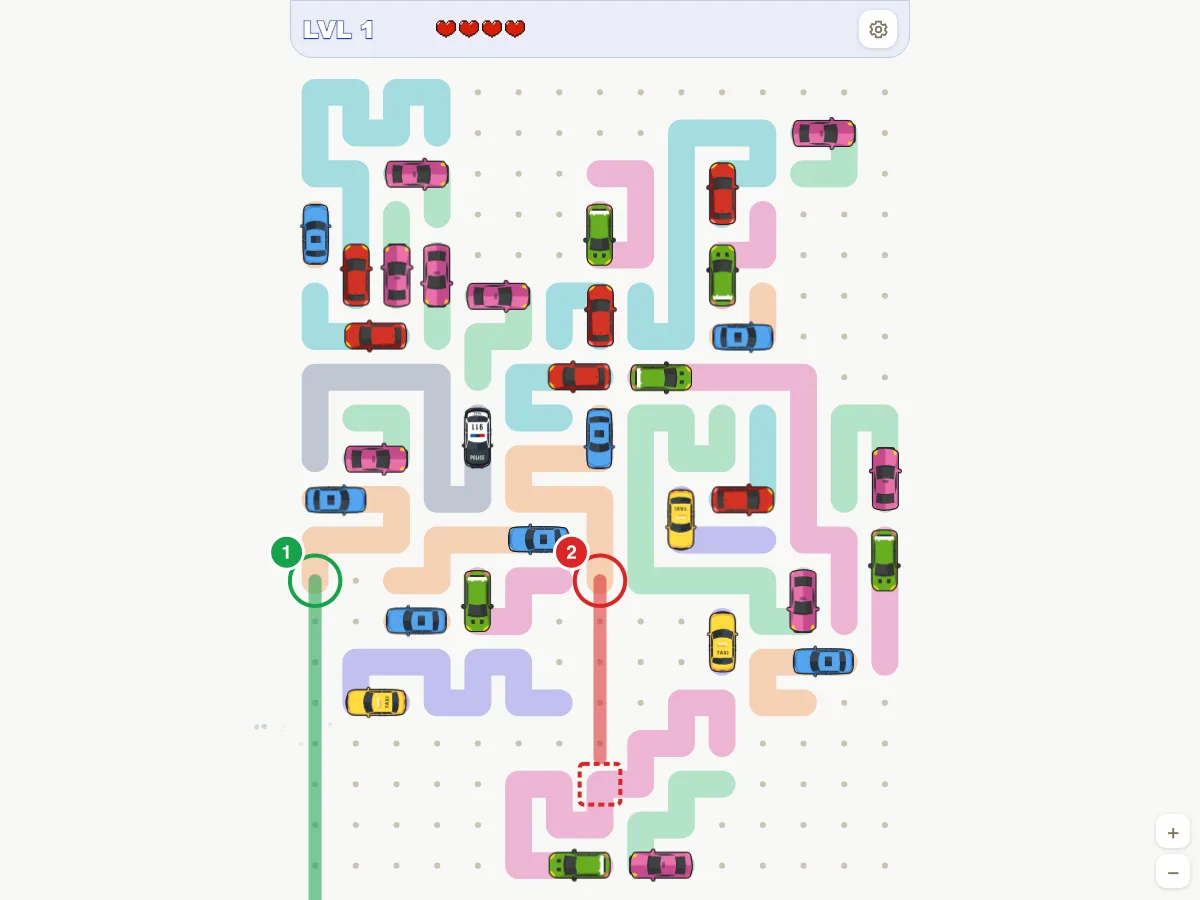
That gives the opening: scan the four edges for cars facing off the board. Those are the complete list of legal first moves, and on a crowded board they may be few. Tap one, and watch the lane it vacates: the vehicle whose nose points into the nearest emptied cell is usually the next one free. Repeat. The board peels in layers, and in the tight stretches exactly one vehicle is free at a time, so the only clue to the next move is the cells that just emptied.
The economy makes reading worth the time. A blocked tap costs one of four hearts, but tapping the same blocked vehicle again is free until something changes. So after a failed tap the right move is to trace that vehicle's lane to the first occupied cell and go after what sits there, not to try a neighbor.
From the second level on, the clock is four seconds per vehicle with a two-minute floor, rounded up to five seconds. That is enough to tap a confirmed vehicle and not enough to hunt for one, so a board of sixty vehicles gives four minutes and a board of a hundred and twenty gives eight. The habit that beats the clock is confirming the next vehicle while the current one is driving off, so that no tap is ever preceded by a search.
Mistakes that cross over badly between the two families
Players who move between the families bring habits that hurt them. The sliding player's instinct is to plan a long sequence before touching anything; in the one-tap game that wastes the clock, because the board only gets easier and the plan is rewritten by every departure. The one-tap player's instinct is to tap whatever looks free; in the sliding game that scrambles the position and makes the backward chain harder to see.
Three habits fail in both directions and are worth naming:
- Judging a vehicle by its size. In the sliding game the long trucks are the blockers to think about; in the one-tap game a long body means nothing and only the nose's lane matters.
- Assuming the goal piece goes first. In the sliding game the red car usually moves last, and the one-tap game has no goal piece at all.
- Retrying too early. In the sliding game a retry throws away a position that may be closer than it looks; in the one-tap game it restores the full board and resets the streak of consecutive clears, when one heart back would usually finish the level.
The comparison of Arrow Escape and Traffic Escape covers the same mismatch from the other side: players arriving at Traffic Escape expecting Rush Hour. The two games on this site are both one-tap puzzles, and the reading habits transfer completely between them.
| Sliding family (Rush Hour, unblock, parking jam) | One-tap family (Traffic Escape) | |
|---|---|---|
| Goal | Free one car to an exit | Empty the whole board |
| Moves | Slide along the vehicle's length; reversible | Drive off the board; permanent |
| Dead ends | Yes; some positions need backward moves | None; every position is solvable |
| Core skill | Backward dependency chains; search | Edge scan; following emptied lanes |
| Cost of error | Wasted moves, a worse position | One heart per blocked tap; clock |
| Formal difficulty | PSPACE-hard in general | Trivial to decide; hard to read fast |
Situations a Traffic Escape player meets, and how to read each
Because Traffic Escape's boards vary, the useful guide is to situations rather than to specific levels. Each of the following recurs, and each has one right reading:
- When no vehicle seems able to move: at least one always can, and it is on an edge, facing outward. Check each edge in turn for a nose pointing off the board. On the tightest boards there may be only one or two, and every other tap is a heart.
- When a long vehicle lies along an edge with its nose free: tap it early. Its body is a wall along that edge, and the vehicles facing that edge from inside are waiting on it. Removing the wall opens a whole row or column at once.
- When a tap is blocked: do not switch vehicles. Trace the blocked vehicle's lane from its nose to the first occupied cell; the vehicle there is your target, or is itself waiting on the one in front of it. The repeat tap is free, so nothing is lost by staying with it.
- When several vehicles are free at once: take the one whose departure empties the longest lane, because a long emptied lane frees more noses than a short one. This is the one place where length matters, and it matters for what it uncovers.
- When the board is nearly clear and hearts are low: prefer the single heart back over a retry. The remaining lanes are short, the clock keeps its value, and the streak survives.
The early-levels walkthrough works through these situations in the order a new player meets them. None of them requires knowing the board in advance; each is recognized by what is on the screen now, which is the point of a method for a game whose boards are not memorized.
A worked opening, on a board that has been measured
The one-tap method is the same in Arrow Escape, and its measured first board shows it concretely. Arrow Escape's first board is fifteen cells wide and twenty tall with 47 arrows, and exactly seven can move at the start: two on the top edge pointing up, four on the bottom edge pointing down, one on the right edge pointing right. Every other arrow has an occupied cell in front of its head.

The chain is visible from the first tap. The right-edge arrow is only four cells long, but the cells it vacates sit directly in front of a 27-cell arrow whose head points right; that giant leaves next. Each top-edge arrow frees an arrow beneath it, and the bottom-edge arrows free short downward arrows that uncover a 15-cell one. After the seven opening moves, six more arrows are free, then four, then five, and the board peels in 21 layers, including six in a row where only one arrow can move.
Traffic Escape's own first board is tighter at the start: 45 cars, three of them facing an open edge. The method is the same, and the example above is what it looks like when it works.
What the puzzle does and does not do for you
Both families are exercises in planning and spatial reading, and practice makes you measurably better at them. Whether that improvement carries anywhere else is a question this site answers cautiously: the largest controlled trial of brain training found gains on every trained task and no transfer to untrained ones, and the research overview lays out that evidence along with the regulatory action taken against a company that claimed otherwise.
What the one-tap family does offer, honestly, is a puzzle with a rare property: it cannot be lost by reasoning badly, only by reading slowly. That is the subject of the article on move order, written for the arrow version and true of the vehicle version by the same rule. For the arrow game, whose boards have been measured level by level, the complete Arrow Escape guide is the most detailed reference on this site.
The preprint of the Hearn and Demaine result is freely available on arXiv for anyone who wants the formal version of why the sliding family is hard. For the one-tap family no such result is needed; the difficulty is the four seconds per vehicle, and the way to beat it is the edge scan.
What to read next
For the game itself, the Traffic Escape early-levels walkthrough covers the first situations a player meets, from the clockless first level to the first board where the edges hold only a couple of free vehicles. Arrow Escape vs Traffic Escape explains what the two games on this site share and which players each will not suit.
The rest of this cluster fills in the background. The Rush Hour history traces the sliding family from the 1880s to its digital clones; why traffic puzzles are mathematically hard explains the formal results in plain terms; seven board patterns names the structures both families reuse. For the other one-tap picture, the Helicopter Escape guide covers the aircraft version, and the three-way comparison gives the one-move test for any traffic app.
For the reading skill in its most measured form, the complete Arrow Escape guide documents openings, chains and hard levels from the actual boards, and every habit in it applies to vehicles as well as arrows.
Or start where the strategy starts: play Traffic Escape, scan the four edges before touching anything, and tap the first car you find facing off the board. If it drives away, you are in the one-tap family and this guide applies from its second section on; if it slides a cell and stops, you are somewhere else entirely.
traffic jam puzzlepuzzle strategyunblock
Play the game

Frequently asked questions
- What is the trick to traffic jam puzzles?
- For sliding puzzles like Rush Hour, work backward from the exit: find what blocks the red car, then what blocks those blockers, and clear from the outside in. For one-tap puzzles like Traffic Escape, scan the edges for vehicles facing off the board, tap those first, and follow the lanes they empty.
- Why can't I solve some traffic jam puzzles?
- In the sliding kind, some positions require long sequences and a few moves that look backward, and the general problem is provably hard, so a hard level may simply need more search. In the one-tap kind, no level can be unsolvable; being stuck means a lane you have not read yet, and every blocked tap costs a heart.
- Is Traffic Escape a Rush Hour game?
- No. In Rush Hour vehicles slide back and forth inside the grid and one red car must reach the exit. In Traffic Escape every vehicle drives off the board when its lane is clear and the goal is to clear them all. The name is shared; the strategy is not, which is why this guide covers both.
Sources
- Rush Hour (puzzle) — Wikipedia (Accessed August 23, 2026)
- PSPACE-Completeness of Sliding-Block Puzzles and Other Problems through the Nondeterministic Constraint Logic Model of Computation — Erik Demaine, Theoretical Computer Science (2005) (Accessed August 23, 2026)
- PSPACE-Completeness of Sliding-Block Puzzles and Other Problems through the Nondeterministic Constraint Logic Model of Computation (preprint) — arXiv (Hearn & Demaine) (Accessed August 23, 2026)
External links are provided for reference and are not endorsements.