
Parking Jam vs Unblock Me vs Traffic Escape
By JingPublished Updated 9 min read1,570 words
In this guide
Parking jam alternatives are easy to list and hard to compare, because the names on them describe a theme rather than a rule. Parking Jam, Unblock Me and Traffic Escape are three names a player searching for a traffic puzzle will meet, and two of them are used across many different apps whose rules this site has not examined. So this comparison does something more useful than ranking: it explains the two families every traffic-themed puzzle belongs to, gives a one-move test to tell which family a given app is in, and places the one game it can describe from its own code.
The two families are the sliding family, descended from the Rush Hour board game, and the one-tap family, which includes Traffic Escape and its siblings on this site. They share vehicles, grids and jams, and share almost nothing in strategy. Everything that follows is about recognizing which one you are holding.
What this comparison can and cannot say
Honesty first. The names Parking Jam and Unblock Me appear on a range of mobile games from different makers, and their rules, level counts, and business models vary by app and by version. This site has not examined those apps, and it will not describe them from memory or from store listings, cite figures for them, or link to them. Anything below about "a parking-style game" or "an unblock-style game" describes a family of rules, not a product.
What can be described precisely is the lineage and the rules of each family. The sliding family's rules are documented in the history of the Rush Hour board game, which is public and unambiguous. The one-tap family's rules are documented in the code of Traffic Escape, which this site publishes and can quote. The comparison is therefore between two rule sets, with the reader supplying the test that assigns any particular app to one of them.
That test is the point of the article. A player who can run it needs no ranking, because the answer to "which parking jam alternative should I play" depends entirely on which family they enjoy, and that is a matter of one move.
The sliding family: Rush Hour and its descendants
The sliding family began as a board game. Wikipedia describes Rush Hour as a sliding block puzzle invented by Nob Yoshigahara in the 1970s, first sold in the United States in 1996, played on a six-by-six grid with grooves that let cars slide. Cars are two squares long and trucks three, all one square wide, and the goal is to get only the red car out through the exit by moving the other vehicles out of its way. Nothing else leaves the board.
The rule has two consequences that define the family's feel. Moves are reversible, so a position can be explored and backed out of. And a position can be a dead end, where the red car is boxed and the way out requires moves that go away from the exit before coming back. The strategy is a search: build the chain of blockers backward from the exit, find the piece that can move freely, and work the chain.
Digital versions kept this rule. Wikipedia records a 2009 mobile game, Blocked, based on Rush Hour, and an official iOS version of Rush Hour in 2010. Many unblock-style games since are recognizably the same puzzle: a grid, sliding blocks, one that must reach the edge. Whether a particular app named Unblock Me or Parking Jam follows this rule is exactly what the one-move test below will tell you.
The one-tap family: Traffic Escape and its siblings
The one-tap family looks like the sliding family and plays differently. In Traffic Escape every vehicle is a long, winding body with a car at the nose, packed so that every cell belongs to a vehicle. A tap sends the vehicle driving off the board in the direction its nose faces, but only if the straight lane from the nose to the edge is empty. If the lane is blocked, the tap fails and costs one of four hearts. Nothing slides within the grid and nothing comes back.
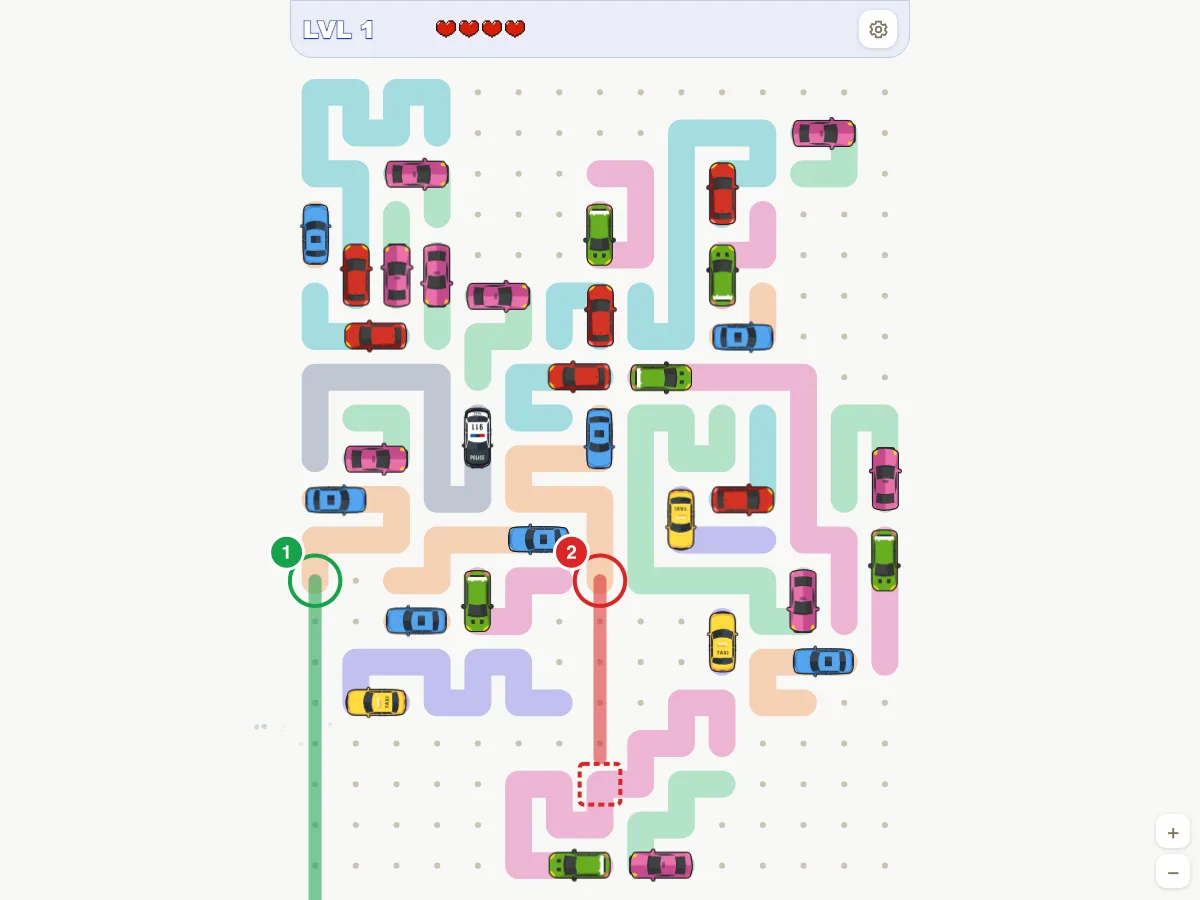
The consequences are the opposite of the sliding family's. A move is permanent and only empties cells, so a vehicle that can leave now can still leave later, and no position is a dead end; any sequence of legal taps clears the board. The strategy is a reading task: scan the four edges for vehicles facing off the board, tap those, and follow the lanes they empty to the next free nose.
The costs are hearts and clock. A blocked tap costs one of four hearts, with the same vehicle free to re-tap, and from the second level on the clock runs at four seconds per vehicle.
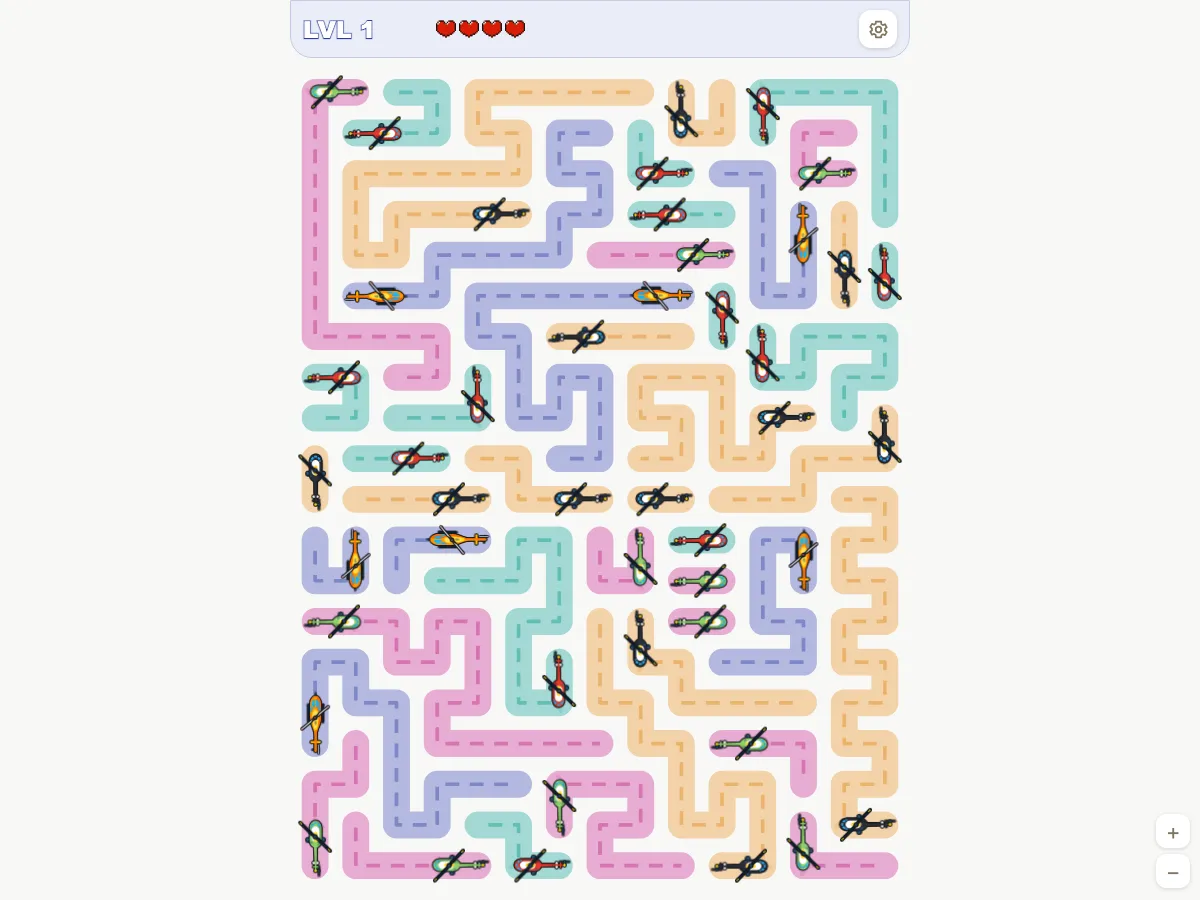
Two sibling games on this site share these rules exactly, with different pictures: Arrow Escape draws arrows, and Helicopter Escape draws dashed flight paths with an aircraft at the nose. The comparison of the arrow and vehicle versions is the honest account of what a change of picture does and does not change.
The one-move test
Every traffic-themed app can be sorted with a single action, and it takes five seconds:
- Open the first level and pick any vehicle that looks free.
- Tap it, or drag it, whichever the game responds to.
- Watch what happens. If the vehicle moves a square or two within the grid and stays on the board, the game is in the sliding family. If it drives off the board and does not come back, the game is in the one-tap family.
- Check the goal. A single highlighted vehicle and an exit gap on the edge means sliding; "clear all" or a counter of remaining vehicles means one-tap.
- Check the cost of a mistake. Wasted moves or a move counter means sliding; hearts, lives or a penalty for tapping a blocked piece means one-tap.
The test works because the two families differ at the level of what a move is, and no theme can hide that. It also protects against the most common disappointment in the genre: arriving at a game expecting the search puzzle of Rush Hour and finding a reading puzzle, or the reverse. The difference is not quality; it is kind, and the traffic puzzle strategy guide gives the method for each.
| Sliding family | One-tap family | |
|---|---|---|
| Ancestor | Rush Hour board game, 1996 | Browser and mobile escape puzzles |
| A move | Slide within the grid; reversible | Drive off the board; permanent |
| Goal | One vehicle to the exit | Empty the board |
| Dead ends | Possible | Impossible |
| Core skill | Backward chain from the exit; search | Edge scan; following emptied lanes |
| Mistake cost | Wasted moves, a worse position | Hearts; clock |
| Formal difficulty | PSPACE-complete when generalized | Trivial to decide; hard to read fast |
| On this site | None | Traffic Escape, Helicopter Escape, Arrow Escape |
Which family suits which player
The sliding family suits players who like a problem they can sit with. A hard Rush Hour position rewards memory, patience and the willingness to make a move that looks wrong, and the difficulty is genuine: Hearn and Demaine proved that sliding-block puzzles are PSPACE-hard, even if the pieces are restricted to be all dominoes, so no rule of thumb solves every level. Players who want a puzzle to be a search will find it here and will find the one-tap family thin.
The one-tap family suits players who like reading under a clock. There is nothing to sit with, because no position can be stuck; there is a board with a few free vehicles on it and four seconds per vehicle to find them. Players who enjoy scanning, spotting and keeping a queue of confirmed moves will find it satisfying, and players who want to think ten moves ahead will find there is nothing ten moves ahead to think about.
Neither family is the better one, and a player can enjoy both, as long as they know which they are opening. The patterns that recur in both, the wall along an edge, the chain, the corner, are named in the board patterns article, with a note on which belong to only one family. The reading transfers; the rule does not.
What to read next
The method for each family, side by side, is in how to solve traffic jam puzzles. For the one-tap family's other pictures, the Helicopter Escape guide covers the aircraft version, including the grey marker it alone puts on a blocked piece, and Arrow Escape vs Traffic Escape says which players each picture will not suit.
And for the one game this article can describe from its own code, play Traffic Escape and run the one-move test on it: the first car you tap with a clear lane will drive off the board and not come back, which places it, and everything else here, in the family where nothing can trap you.
Run the same test on the next app called a parking or unblock game that you open, and you will know in five seconds whether the strategy in your hands is the search or the scan, which is more than any listing will tell you.
parking jamunblock mecomparison
Play the game

Frequently asked questions
- Are Parking Jam and Unblock Me the same kind of game?
- The names are used across many apps this site has not examined, so it makes no claim about any particular one. What it can say is that every traffic-themed puzzle belongs to one of two families, sliding or one-tap, and one move tells you which: a vehicle that stays is one, a vehicle that leaves is the other.
- Which family is Traffic Escape in?
- The one-tap family. Every vehicle drives off the board when the straight lane ahead of its nose is clear, a blocked tap costs one of four hearts, the first level has no clock and later ones give four seconds per vehicle. There is no red car and no exit square, and no position can trap you.
- Why do the strategies differ so much?
- Because one family is a search and the other is a reading task. Sliding puzzles are formally hard, PSPACE-complete when generalized, and a hard level needs a long sequence with backward moves. One-tap puzzles can never be unsolvable, so all the difficulty is in finding the free vehicle before the clock does.
Sources
- Rush Hour (puzzle) — Wikipedia (Accessed July 30, 2026)
- PSPACE-Completeness of Sliding-Block Puzzles and Other Problems through the Nondeterministic Constraint Logic Model of Computation — Erik Demaine, Theoretical Computer Science (2005) (Accessed July 30, 2026)
External links are provided for reference and are not endorsements.