
Arrow Escape Tips and Tricks for Beginners
By JingPublished Updated 10 min read1,938 words
In this guide
These Arrow Escape tips are short because the game is: tap an arrow, and it leaves the board if the straight line in front of its head is empty, or costs you a heart if it is not. Everything a beginner needs fits into three habits, and we can show each one on level 1 and level 2 of the actual game rather than on an imaginary board.
The habits, in one breath: start with the arrows whose head already touches the edge, because at the beginning of a level they are the only ones that can move. After each exit, look at the cells that just emptied and ask which arrow was waiting on them. And never tap an arrow whose line you have not traced to the edge, because guessing is the only thing in this game that costs hearts.
Arrow Escape tips in one minute: the three habits
Every level is packed solid. Each cell belongs to an arrow, and an arrow can only leave when the cell in front of its head is empty, then the next one, and so on to the edge. At the start of a level no cell is empty, so the only arrows that can move are the ones whose head is already on the edge and pointing off it. True of all 100 boards: level 1 has 7 such arrows, level 2 has 8, and level 3 has exactly one.
- Scan the four edges before the middle, and tap the arrows whose heads sit on an edge pointing off it.
- Follow the chain. When an arrow leaves, its cells become empty, and the arrow that had been pointing into those cells is the next candidate.
- Trace before you tap. Following a line from an arrowhead to the edge takes a second or two; a wrong tap costs a quarter of your hearts.
A fourth habit for anyone who has played a while: judge an arrow by its head, not its length. On more than half of the 100 levels the longest arrow leaves in the first quarter of the solve, because a long snake often ends at an edge; on level 47 it is not movable until past halfway. The line in front of the head tells you everything. Six more habits like these, with fixes, are in seven common Arrow Escape mistakes.
Start with the arrows whose heads touch the edge
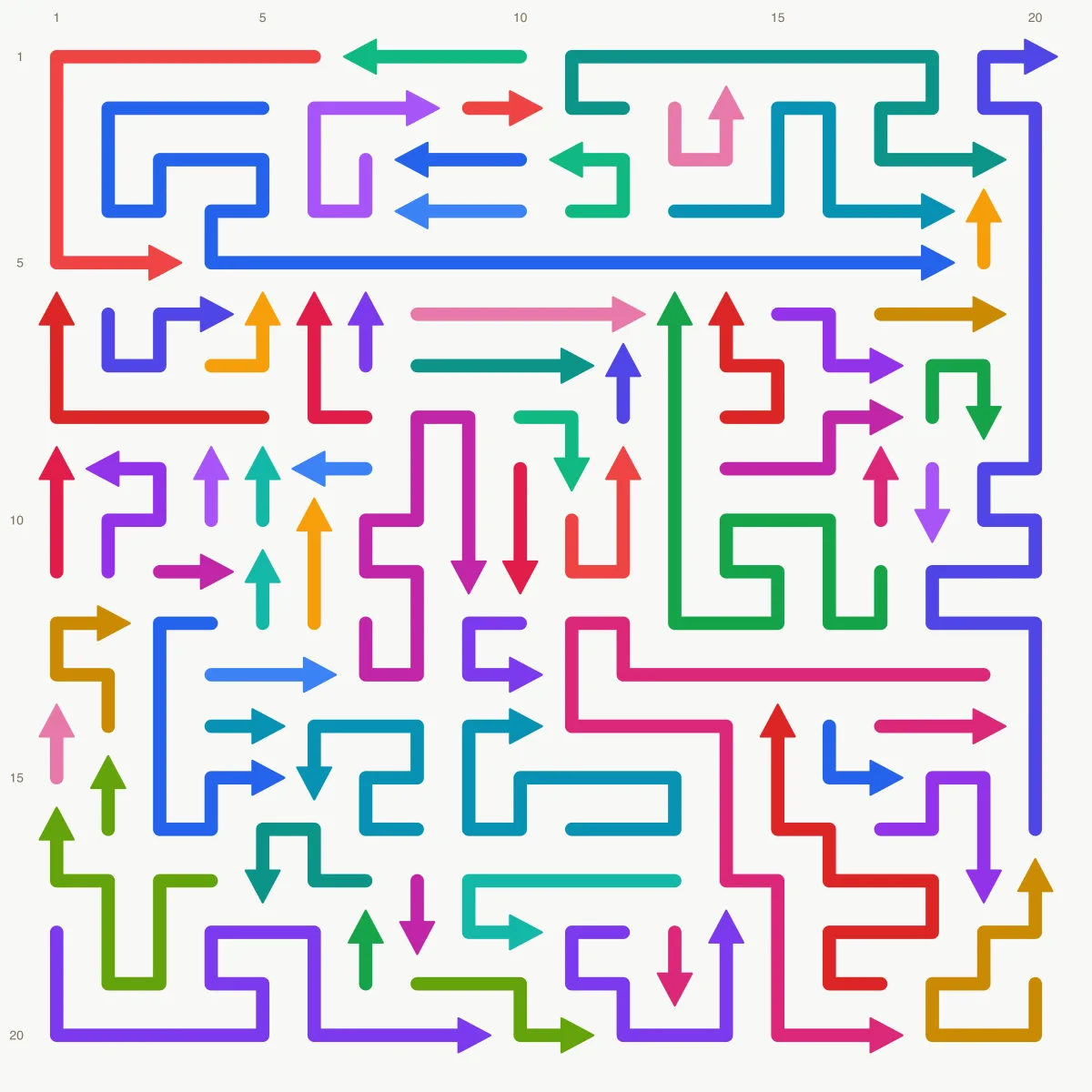
On level 1 the board is 15 cells wide and 20 tall, with 47 arrows. Along the top edge you find two arrowheads pointing straight up, in the second and fifth columns from the left. Along the bottom edge there are four pointing down: one in the far-left column and three next to each other in the eleventh to thirteenth columns. On the right edge, six rows down, one arrowhead points right. That is seven arrows, and they are the entire list of legal first moves.

Try anything else and you will see the cost. The obvious first target is the long arrow in the upper half, a 27-cell snake whose head points right. Its head is three cells short of the right edge, and all three of those cells belong to the small 4-cell arrow sitting on the edge. Tap the giant first and you lose a heart. Tap the small edge arrow first and the giant leaves on the very next tap.
The same scan works on every board, and it gets more valuable as boards grow, because the share of movable arrows drops. Level 2 has 8 movable arrows out of 56, five of them on the right edge. Level 10, the first big board, has 6 movable arrows out of 162. On a board like that, tapping a random arrow is a 96 percent chance of losing a heart, and scanning the edges is the only way to find the other 4 percent.
Follow the chain: what one exit opens up
Once the edge arrows are gone, the empty cells they leave behind are the new edge. On level 1, after the seven opening moves, six arrows become free, and each one was blocked by exactly one of the seven you just removed. The right-edge arrow frees the 27-cell giant. The top-edge arrow in the fifth column frees a 9-cell arrow directly below it. The bottom-left arrow frees a 7-cell arrow pointing left along the second-to-last row.
So the routine is: tap an edge arrow, watch which cells empty, and look for the arrowhead that was pointing into the nearest of those cells. On level 2, the upward arrow in the top-right corner frees a 17-cell arrow pointing right along the second row, and the downward arrow in the thirteenth column of the bottom edge frees a 4-cell arrow pointing right beside it. These chains are short, one or two links, but they are how you reach the middle of the board without guessing.
The chain is also why a level can stall. Level 1 has six moves in a row where only one arrow is free: a 21-cell arrow pointing down in the top-right region, then a 6-cell arrow pointing up, then a 2-cell arrow pointing right, then a 4-cell arrow pointing up, then an 18-cell arrow pointing up, then a 16-cell arrow pointing right. If you lose the thread, do not tap around to find it. Go back to the last cell that emptied and look at what was pointing at it.
Why you lose hearts, and the one rule most players miss
A blocked tap costs one heart, and you have four per level. The rule most players miss is what counts as a second blocked tap. If you tap a blocked arrow and then tap the same arrow again, the second tap is free. The game remembers the last arrow that blocked you and only charges again when you tap a different blocked arrow. That memory is cleared whenever an arrow leaves, when you retry, and when you accept the extra heart after running out.
So tapping the same arrow twice out of frustration costs one heart, not two, but tapping two different wrong arrows costs two. That shapes the smart response to a mistake. If a tap is blocked, do not try a neighbor. Look at the arrow that flashed, follow its line to the edge, and find the occupied cell. The arrow in that cell is your real target, or is itself blocked by the arrow that is.
Level 3, the first square board, is where this rule earns its keep. Every arrow but one is blocked at the start, and the one that moves is the 24-cell arrow in the top-right corner pointing right. Players who lose all four hearts on level 3 lose them on four different arrows in the middle. When hearts hit zero you can accept one heart back and continue, or retry from the start. If most of the board is already cleared, the single heart is usually the better deal.
The clock: learn on level 1, then respect four seconds per arrow
Level 1 has no timer, which makes it the right place to practice the tracing habit slowly. From level 2 onward every board has a clock, and its length is not arbitrary: four seconds for each arrow on the board, rounded up to the next five seconds. Level 2 has 56 arrows and starts at 3:45. Level 47 has 109 arrows and starts at 7:20. Level 100 has 241 arrows and starts at 16:05.
Four seconds per arrow is tight if you spend it thinking and comfortable if you spend it tapping arrows you have already confirmed. The routine that works on the larger boards is to keep two or three confirmed arrows in mind, tap one, and use the moment while it slides off to trace the next candidate. The clock is not measuring how fast you can think. It is measuring how much of your thinking you do in advance.
If the clock runs out you get two options: two extra minutes on the current board, or retry. Two minutes is thirty arrows' worth of time at the normal rate, and the board stays as you left it, so it is almost always worth taking when the board is more than half empty. The clock also pauses on every overlay, so reading the level-complete screen costs nothing.
There is a reason these boards cannot be rushed by rule of thumb. Deciding whether a Rush Hour style sliding puzzle has a solution is PSPACE-complete when the board is allowed to grow, and Hearn and Demaine proved that classic sliding-block puzzles stay PSPACE-hard even with domino pieces. Arrow Escape is gentler, since every move removes a piece and the board only gets emptier, but there is still no shortcut around reading the lines.
How long a session really takes
Our own sessions run about twenty levels and about forty minutes, and they end when the hearts run out rather than when we decide to stop. That is a fair estimate for a player who has the three habits down and is not yet on the big boards. The tens boards change the rhythm: level 10 alone has 162 arrows and a ten-minute clock, so a session that reaches it has one long level in the middle of nine short ones.
The game keeps a streak, the number of levels cleared in a row without pressing retry. Losing hearts does not break it, and neither does taking the extra heart or the extra two minutes; only retry does. Banners appear at streaks of 3, 5, 10 and 15, and the game remembers your best. Ours is 7, and honestly the streak is the number we play for. Once you care about it, retry stops being a free reset and becomes a decision.
Progress lives in the browser you play in. It stays on that device, needs no account, and clearing site data takes you back to level 1. If you switch between a phone and a desktop, expect two separate sets of progress.
What to read next
The habits above are enough for the first ten levels, and they are worth making automatic before the boards get large. Level 1 has no clock, so use it to practice the edge scan and the tracing habit until you no longer have to think about them. By level 3 you will need both, and by level 10 you will need them fast. Ten levels of that is enough to make the edge scan a reflex.
The same three habits clear the vehicle version of this game, and how to solve traffic jam puzzles shows where Traffic Escape's rules match these and where the wider genre parts ways.
For the boards after that, the complete Arrow Escape guide walks through level 1 move by move, explains what changes on levels 3, 47 and 100, and lists the hardest levels by the numbers. Why the chain habit works, and why no order can ever trap you, is in why move order decides arrow puzzles. Or skip the reading and play Arrow Escape now: start at level 1, find the seven edge arrows, and see how far the chain takes you before the first heart goes.
arrow escapepuzzle strategybeginner tips
Play the game

Frequently asked questions
- Why do I keep losing hearts in Arrow Escape?
- Every tap on an arrow whose straight line to the edge is not empty costs a heart. Early on, the only arrows with an empty line are the ones whose head already sits on the edge, pointing off it. Trace the line from the arrowhead to the edge before every tap, and tap edge arrows first.
- How long does it take to finish Arrow Escape?
- There are 100 levels. A session of about twenty levels takes us around forty minutes, so a full run is several sittings. The clock per level runs from under four minutes on level 2 to just over sixteen minutes on level 100, and level 1 has no timer.
- What happens when the timer runs out in Arrow Escape?
- The board freezes and you are offered two choices: add two minutes and continue with the board exactly as it is, or retry. Retry puts back every arrow you removed, restores all four hearts and restarts the full clock, but it also resets your streak of consecutive clears to zero.
Sources
- Rush Hour (puzzle) — Wikipedia (Accessed August 14, 2026)
- PSPACE-Completeness of Sliding-Block Puzzles and Other Problems through the Nondeterministic Constraint Logic Model of Computation — arXiv (Accessed August 14, 2026)
External links are provided for reference and are not endorsements.