
What Makes a Good Puzzle Level: A Designer's View
By JingPublished Updated 11 min read1,998 words
In this guide
Puzzle level design is usually discussed in adjectives: tight, elegant, unfair, satisfying. This article uses numbers instead. Behind this site's Arrow Escape guides sit all 100 of the game's boards, measured arrow by arrow, and four quantities from those measurements say most of what an adjective would: how many moves are legal at the start, how many phases the board peels in, how far a player has to trace before a tap is safe, and what a wrong tap costs.
The answer those four give is a definition. A good level offers a choice the player can read, grows its depth without stalling, prices a mistake to match the rule set, and sits in a curve where the levels around it make sense of it. The sections below take each in turn, with the research on puzzle difficulty where it applies and the boards where it is measurable.
Puzzle level design starts with one number: how many moves are legal right now
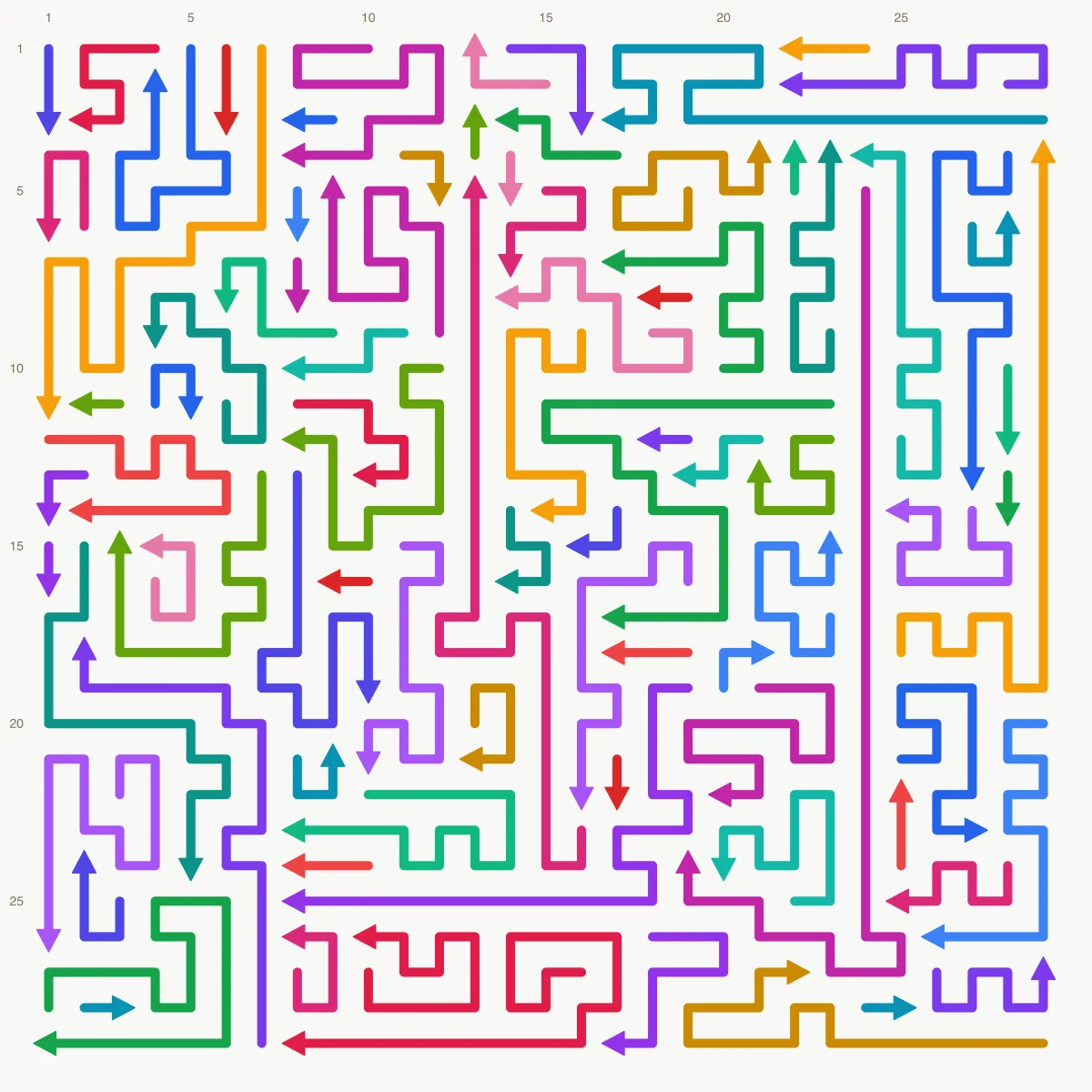
On a packed board the only arrows that can move at the start are those whose head sits on an edge pointing off it, so the first quantity is simply how many of those a level offers. Across the 100 levels the median opening is six or seven legal arrows: 51 levels open with five to seven, 22 with eight to ten, 14 with three or four, ten with eleven or more, and three with one or two.
That distribution is a design decision, and it is the most visible one in the game. The boards triple in size from the first ten levels to the last ten, but the average opening barely moves, from about six legal arrows to about eight. The growth goes into depth, not into the start, which keeps the first thirty seconds of a late level as readable as the first thirty seconds of an early one.
The three exceptions are levels 3, 39 and 96, with one, two and two legal arrows. On level 3 a random first tap loses a heart 98 percent of the time, and it arrives after two boards that forgave almost anything. That is either a lesson delivered early or a trap set for a player who has not learned the rule yet, and a designer could argue it both ways. How to beat hard Arrow Escape levels gives the real openings for all three.
Depth: how many layers a board peels in, and why depth per arrow matters more
The second quantity is depth. Remove every legal arrow, look again, remove everything that is now legal, and repeat; each round is a layer, and the number of layers is the smallest number of phases a player has to pass through. Why move order decides arrow puzzles explains the idea. The average level peels in 44 layers, rising from 27 in the first ten levels to 57 in the last ten.
Raw depth is less telling than depth per arrow, because a big board earns layers just by being big. Level 10 and level 86 have almost the same number of arrows, 162 against 164, and peel in 39 and 65 layers. The first is a large board that comes apart in wide rounds; the second is a large board that keeps closing to a single legal move.
The most sequential boards in the game by this ratio are levels 47, 18 and 11, each with roughly one layer for every two arrows; the loosest are levels 3, 29, 10, 68 and 97, at about one layer per four.
Within depth, the rounds of width one are the ones players feel. A single-choice layer has one correct arrow and dozens of wrong ones. The average level has eleven; 59 levels have ten or more; level 86 has 27, and levels 57 and 91 each run ten single-choice layers in a row. A designer who wants a level to feel strict raises this count, and one who wants it to feel generous keeps the layers wide even when there are many of them.
Two sources of difficulty, and the research that separates them
Puzzle difficulty has been studied most carefully in Sudoku, where solving data exists at scale. Radek Pelanek evaluated the standard rating metrics against more than 1,700 puzzles and hundreds of solvers, found that a computational model of human solving predicted best, and drew a conclusion that transfers: there are two sources of the problem difficulty, the complexity of individual steps and the structure of dependency among steps.
Both have a direct measure on an arrow board. The complexity of a step is how far a player must trace before a tap is known to be safe, which is the number of arrows sitting on the exit line of the arrow in question.
At the start of an average level each exit line crosses about six other arrows; on level 1 the figure is under three, on level 100 it is eight, and the most buried arrow in the game, on level 40, has 31 arrows on its line. The dependency structure is the layer count above, and especially the single-choice layers and how long they run.
The two are independent knobs, and the levels that feel unfair are the ones where both are turned up together. Level 86 has the highest single-choice count and a line 26 arrows deep, so every trace is long and every choice is forced. Level 3 turns up neither; it is hard for exactly one tap because the target is tiny. A good level picks which source it is raising, and the best ones alternate, so a stretch of long traces is followed by short forced ones.
Dead ends: the design choice that decides what a mistake costs
The largest decision in puzzle level design is whether a wrong move can ruin the level. In Sokoban it can: Wikipedia notes that careless moves can leave a box permanently trapped, and that any such situation creates a deadlock that makes the puzzle unsolvable, regardless of future moves. Sliding-block puzzles in general are formally deep for the same reason; Hearn and Demaine proved them PSPACE-hard even when every piece is a domino, so no shortcut exists for telling a live position from a dead one.
Arrow puzzles remove that possibility by rule. A departure only empties cells, so a legal arrow stays legal until it is tapped and no order can make a solvable board unsolvable. That buys pace and loses search, and it leaves the designer with a second decision: if a mistake cannot cost the level, what does it cost? Arrow Escape answers with four hearts per level and a clock, and it makes a wrong tap informative, since the tapped arrow flashes and a repeat tap on it is free.
Four hearts is a budget for misreads, not for guessing. A random tap on an average board is legal about one time in twenty, so four guesses will rarely find an opening; the budget is meant for the near miss, the arrow whose line looked clear from a distance. Whether that pricing is right for a given player is the question how to solve traffic jam puzzles treats across both families, the sliding kind where the cost is the level and the one-tap kind where the cost is a heart.
The difficulty curve: what grows, what stays flat, and where it breaks
A level is judged partly by its neighbors, so the fifth measure is the curve. The table gives the averages for each block of ten levels.
| Levels | Arrows | Legal at start | Layers | Single-choice layers | Arrows per exit line |
|---|---|---|---|---|---|
| 1 to 10 | 80 | 5.8 | 27 | 6.5 | 4.1 |
| 11 to 20 | 103 | 5.6 | 39 | 11.3 | 5.0 |
| 21 to 30 | 112 | 6.6 | 35 | 7.3 | 5.1 |
| 31 to 40 | 115 | 6.4 | 40 | 10.0 | 5.3 |
| 41 to 50 | 119 | 6.7 | 45 | 12.6 | 5.6 |
| 51 to 60 | 136 | 7.0 | 46 | 12.8 | 5.9 |
| 61 to 70 | 142 | 6.8 | 45 | 9.9 | 5.9 |
| 71 to 80 | 153 | 8.3 | 51 | 12.0 | 6.5 |
| 81 to 90 | 161 | 6.4 | 55 | 14.0 | 6.4 |
| 91 to 100 | 173 | 8.4 | 57 | 15.7 | 6.5 |
Three things grow steadily: the arrow count, the layer count and the trace length. One stays flat, the opening. And one is deliberately or accidentally uneven: the single-choice count climbs through levels 11 to 20, falls back for 21 to 30, and dips again at 61 to 70 before the final climb. Read as a curve, those are rests.
Inside the blocks are the spikes. Measured against their neighbors, the single-choice count jumps at levels 11, 18, 20, 28, 35, 47, 55, 65, 73, 86, 91 and 92, roughly one test every eight to ten levels, and the opening collapses at 3, 39 and 96, the same lesson repeated at higher stakes.
The tens boards run the other way: level 100 has 241 arrows and 77 layers, but ten legal openings and a widest layer of fourteen. It is the biggest board in the game and far from the hardest, which is what a finale should be.
A checklist for judging any puzzle level
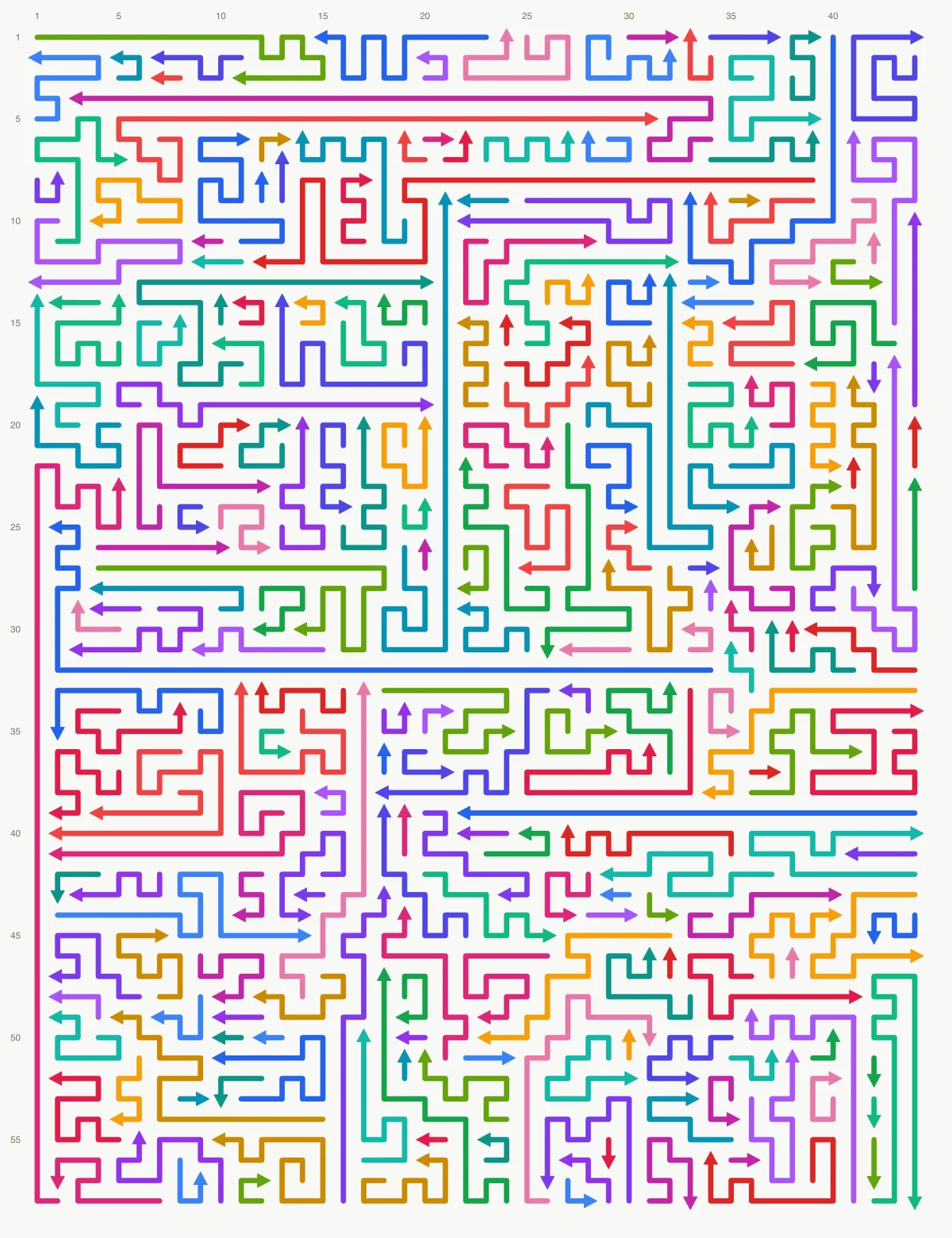
The measures above were taken on one game, but none of them is specific to it. Any level in the one-tap family, and most in the sliding family, can be scored the same way with a solver and an afternoon. In order of how much each one explains:
- Count the legal moves at the start. Fewer than three is a test; more than ten is a warm-up. Decide which the level is meant to be.
- Peel the level and count the layers, then divide by the number of pieces. Around one layer per two pieces is strict; one per four is loose.
- Count the single-choice layers and the longest run of them. This is the dependency structure, and it is what players call "forced."
- For each piece, count how many others sit on its exit line at the start. The average is the cost of a step; the maximum is the deepest trap.
- Ask what a wrong move costs, and whether the rule set makes the wrong move informative. Dead ends are a choice, not a given.
- Place the level in its curve. A spike after a rest is a test; a spike after a spike is fatigue.
A level that scores well on all six is not guaranteed to be loved, but a level that scores badly on any two is reliably disliked, and the pairing that draws the most complaints is a long trace inside a long forced run. On the measured boards that pairing is rare before level 40 and common after 80, which is roughly where players say the game changes character.
What to read next
The numbers here come from the same measurements as the complete Arrow Escape guide, which walks through what they mean on level 1, level 47 and level 100 in turn. For the levels that score as tests, how to beat hard Arrow Escape levels gives their actual openings, and why move order decides arrow puzzles is the theory of layers in full.
Or take the checklist to a board: play Arrow Escape and score level 3 yourself. One legal opening, fourteen layers, two of them forced, and a widest layer of ten: strict for a single tap, then generous. Whether that is good design is exactly the kind of question the numbers can sharpen and cannot settle.
The six measures need nothing more than a solver that can list the legal moves of a position. Every count above is a loop over that list, applied to each of the 100 boards in turn, and the same loop would score a level from any game in the one-tap family, or from the sliding family with a search added for dead ends.
puzzle level designarrow escapepuzzle strategy
Play the game

Frequently asked questions
- What makes a puzzle level good rather than just hard?
- A good level makes its difficulty readable. The player can tell how many moves are legal, can see what the last move opened, and pays for a mistake in proportion to the misread. A merely hard level hides the legal moves behind long traces and long forced chains at the same time, so effort and progress stop matching.
- Why do some Arrow Escape levels feel unfair?
- Because two kinds of difficulty stack. On level 86 the exit lines are long and there are 27 layers with exactly one legal arrow, so every trace is long and every choice is forced. On level 3 there is one legal opening among 65 arrows, which punishes a player who has only seen two easy boards.
- Is a level with no dead ends too easy?
- Not by itself. Removing dead ends removes search, so the depth has to come from reading: how far a player must trace before a tap is safe, and how many phases have a single correct move. Arrow Escape's most sequential board peels in 56 layers for 109 arrows, which is plenty of structure without a single trap.
Sources
- Difficulty Rating of Sudoku Puzzles: An Overview and Evaluation — arXiv (Radek Pelanek, 2014) (Accessed July 9, 2026)
- Sokoban — Wikipedia (Accessed July 9, 2026)
- PSPACE-Completeness of Sliding-Block Puzzles and Other Problems through the Nondeterministic Constraint Logic Model of Computation — Erik Demaine, Theoretical Computer Science (2005) (Accessed July 9, 2026)
External links are provided for reference and are not endorsements.